Roof Vent Repair in San Antonio: Leaks, Failed Boots and Broken Vents
Most vent leaks come from the flashing or the rubber collar around the vent, not the vent itself. We find which part failed and fix that.

Quick answer
A roof vent repair usually means replacing a cracked pipe boot, reflashing a vent whose base has lifted or rusted, or replacing a broken turbine, box vent or exhaust cap. Most vent leaks are the flashing or the rubber collar, not the vent itself. Repairs start at $497, with photos of the failure and a written scope before any work.
Vent types we repair
How each one fails, and what the repair or replacement is.
Plumbing vent pipe boots (pipe jacks)
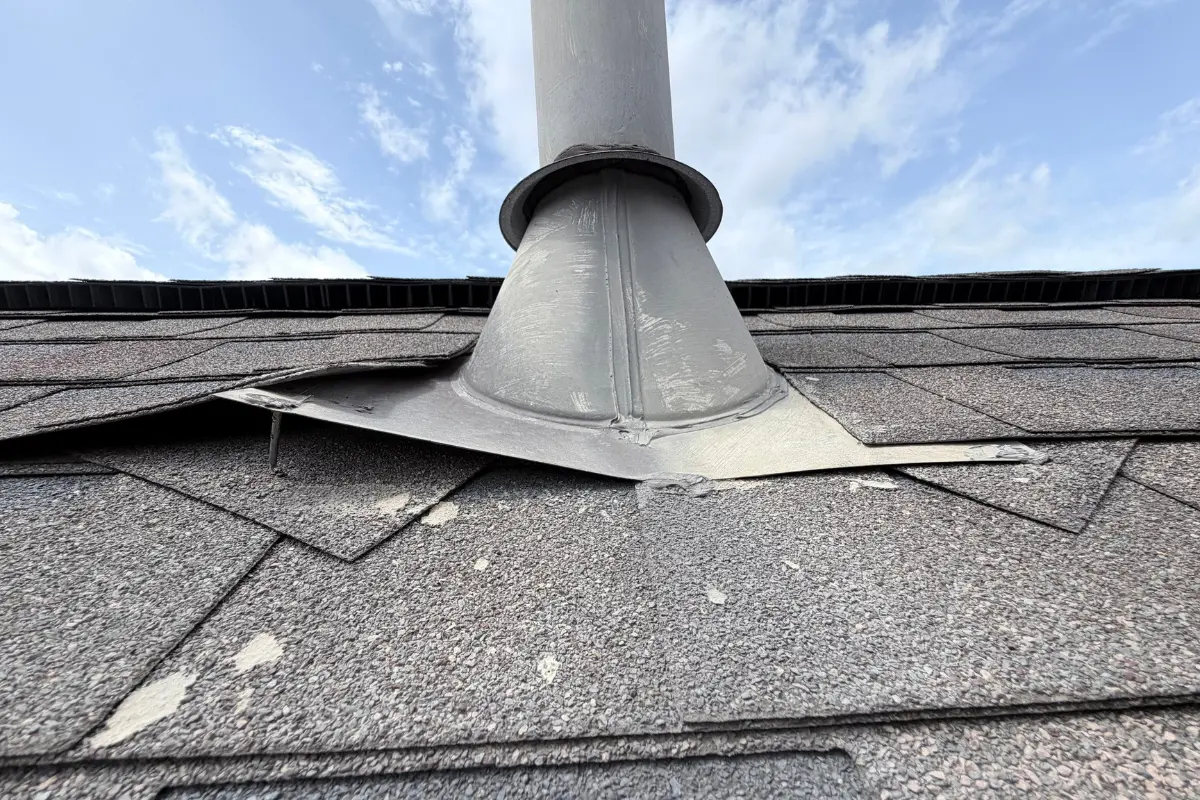
How it fails: The rubber collar around the pipe cracks and shrinks in the sun, so water runs down the outside of the pipe into the ceiling. Squirrels also chew collars, and some boots were face-nailed or never tucked under the course above.
The fix: Replace the boot with a new flashing slid under the upslope shingles and nailed where the shingles cover it. Where the metal base is still sound and the shingles are young, a storm collar or a replacement collar can be the right call.
Static box vents
How it fails: Cracked plastic or rusted metal hoods, hail-split housings, loose fasteners and a lower flange that was laid on top of the shingles instead of over them in the right order.
The fix: Replace the vent with a matching net free area, reflash it into the shingle courses and seal exposed fasteners. Missing or extra box vents are a ventilation question, covered below.
Turbine vents
How it fails: Worn bearings squeal, wobble or seize, dented heads stop spinning, and the base flashing rusts or lifts. A turbine that stops turning in a storm lets wind-driven rain in.
The fix: Replace the head or the whole turbine and its base flashing. If the turbines sit beside a ridge vent, we will tell you that the setup itself is the problem before replacing parts.
Ridge vents
How it fails: Wind lifts or cracks the cap shingles, fasteners back out, the filter fabric tears, or the product was installed over an uncut or overcut slot. Leaks show up mostly in wind-driven rain.
The fix: Refasten or replace the damaged section with the correct nails, replace failed cap shingles and confirm the slot width matches the product.
Powered and solar attic fans
How it fails: Motors fail, thermostats stick, housings crack, and the flashing around the large opening lifts. A dead fan blocks a large opening without moving air, and a cracked housing lets water in.
The fix: Replace the motor or the unit, or remove it and patch the deck when the attic does not need a fan. That second choice is a ventilation decision, not a repair.
Kitchen and bath exhaust roof caps
How it fails: Broken dampers, rusted caps, failed flashing, and ducts that came loose below the cap so the fan blows into the attic instead of outside.
The fix: Replace the cap and flashing, and reconnect the duct to it in the attic. A fan that dumps moist air into the attic causes problems no vent cap can fix.
How to tell the leak is the vent
Signs that point to a vent rather than the shingles or a valley.
- A ceiling stain roughly below a vent, often round, that grows after rain.
- In the attic: wet or dark wood around the pipe or vent opening, damp insulation right under it, or a drip mark on the pipe itself.
- Water tracks running down the outside of a plumbing vent pipe in the attic.
- Stains that appear only during wind-driven rain, which points to ridge vents, turbines and box vents more than to shingles.
- From the ground or a photo: a rusted flange, a cracked or gapped rubber collar, or shingles lifted at the flange.
- Old sealant that has cracked or pulled away from the vent, often a sign of an earlier patch.
- A turbine that squeals, wobbles or will not spin.
- Nests, droppings, chewed collars or animal damage around a vent.
Water coming through the ceiling right now? Go to emergency roof repair first.
Why vents fail early in Central Texas
Sun and heat break down rubber collars and sealants long before they wear out shingles or metal. That is why vent flashing is one of the most common early repairs we make here, often on roofs that otherwise look fine. Our article on flashing failure modes covers how pipe boots and other flashings fail in detail.
Repair the vent, replace the vent, or replace every boot?
Repair fits when the vent body is sound and only a fastener, a seal or a cap section failed.
Replace the vent when the collar is cracked, the housing is broken, the flange is rusted through or the vent was flashed in the wrong order.
Replace all the boots when several are already cracked. Collars installed on the same day age at the same rate, so the ones that look fine now are usually next. We show you photos of each one and let you choose.
When a vent problem is really a ventilation problem
Some vent complaints are not repairs at all: a very hot attic, turbines mixed with a ridge vent, the wrong mix of box vents, or a bath or kitchen fan blowing into the attic. Adding, removing or swapping vents is a ventilation design decision, sized from the attic, not a patch. Our attic ventilation service covers that work, and the attic ventilation calculator shows what your attic needs.
When the roof itself is near the end
If the shingles are worn out or leaking in several places, fixing one vent only buys time, and we will tell you that plainly. In that case, look at roof replacement.
Standard ventilation, balanced intake and exhaust sized to code, is included in the replacement price. Enhanced ventilation, such as solar or powered attic fans or added intake beyond the standard design, is quoted separately.
How it works
- 1.Get My Free Roof Inspection. We check every vent on the roof and the attic below, and photograph what we find.
- 2.You get a written scope and price. Repairs start at $497.
- 3.You approve before any work starts.
See all our roof repairs.
Roof vent repair FAQs
Related reading
Every common repair we do, and how we price it.
ReadWhen the vent problem is really a ventilation problem.
ReadYour intake and exhaust requirement in square inches.
ReadWhy pipe boots are the shortest-lived flashing on a roof.
ReadWhich exhaust fits your roof, and why never both.
ReadWhat to do when water is coming in right now.
ReadPick your inspection time online
Takes about a minute. Free, engineer-led, with a written report either way.
Let's find the leak.
No pressure, no obligation. Calls answered 24/7 in English & español by Alex, our AI specialist · Get an engineer-led 53-point roof inspection, not a sales pitch.