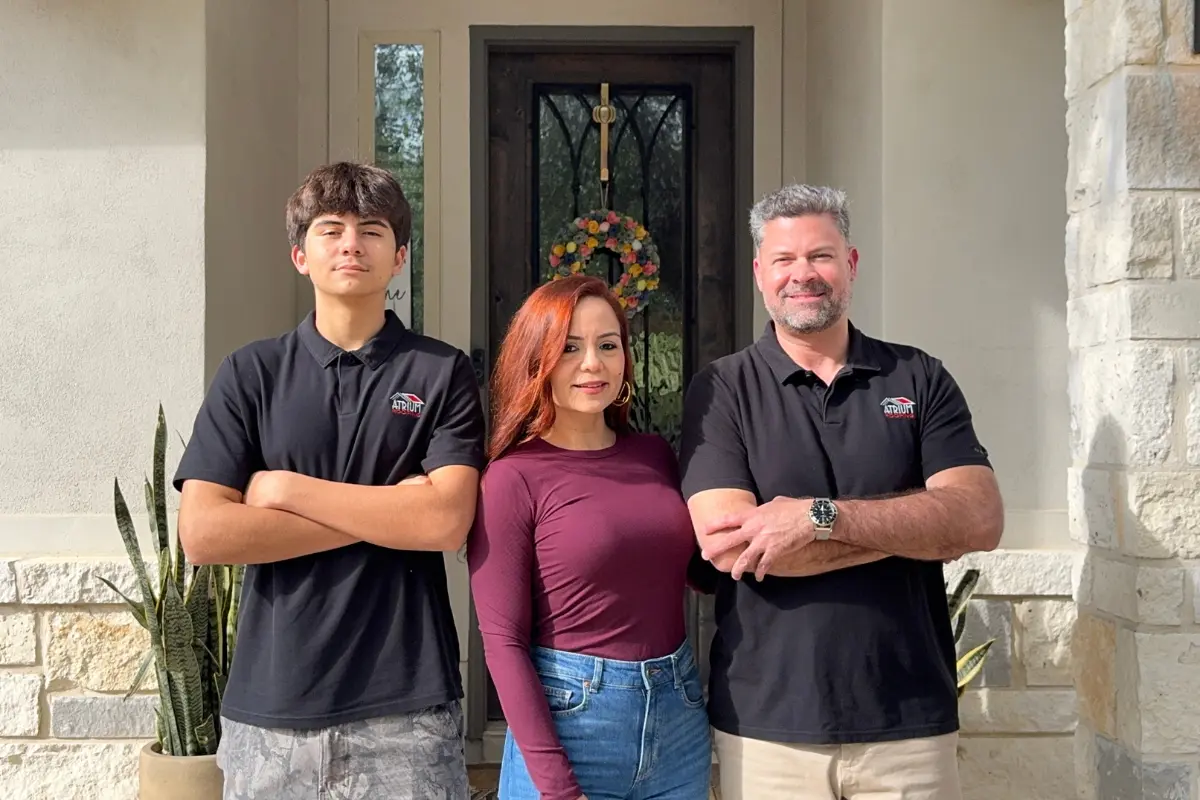
Atrium Roofing crew installing an engineer-led roofing system on a San Antonio residence.
Bandera County · Hill Country · Roofing knowledge center

The Complete Roofing Guide for Bandera

In Bandera County, metal is not a premium upgrade — it is what roofs look like. The dominant roofing question here is not whether to go metal, it is whether a 25-year-old exposed-fastener roof should be re-screwed or replaced.
Local introduction

Roofing in Bandera, and why it isn't like anywhere else

Bandera sits about 50 miles northwest of San Antonio on SH-16, county seat of Bandera County, on the Medina River in the Hill Country. It calls itself the Cowboy Capital of the World, and the building tradition follows: exposed-fastener metal on ranch houses, barns, arenas, and outbuildings is simply the vernacular. Nobody here needs to be sold on metal roofing. They already own one, often two or three counting the outbuildings, and what they need is an honest read on how much life is left in it.

The ground helps. Bandera County is limestone with thin caliche, so the seasonal soil movement that cracks rigid flashing joints across the eastern metro is largely absent. Foundation-driven flashing failure is rare here. What replaces it is fastener fatigue on aging metal, wildfire exposure through heavy Ashe juniper, sustained wind on exposed ridge positions, real hail, and limb impact and leaf load under the cypress and pecan canopy along the Medina River.

Climate & weather

How Bandera weather actually loads your roof

Limestone underfoot means the loads that shorten a Bandera roof come from above and from the fastener line — not from the slab.

Thermal cycling on exposed-fastener metal
Panels expand and contract daily against fixed screws. Over 15 to 40 years the screws back out and the neoprene gaskets harden and crack. This is the single most common failure mode in the county.
Wildfire in the Ashe juniper
Cedar carries fire fast and terrain moves it uphill. Embers entering unscreened vents, open soffits, and debris-packed valleys are the realistic loss mechanism — not flame contact on the panel.
Wind on exposed ridges
Hilltop and ranch positions have no upwind obstruction. Panel terminations, ridge caps, closures, and rake trim move first; the field of the panel rarely fails.
Hail
Bandera County takes genuine hail. On asphalt that means Class 4 is the correct specification. On metal it means a denting conversation that is usually cosmetic rather than functional.
Ultraviolet load
Thin canopy on ranch and ridge lots means unfiltered sun all day. Paint systems chalk, asphalt oxidizes early, and south and west slopes age years ahead of the north side.
Medina River canopy
Mature cypress and pecan along the corridor deliver limb impact in wind events and pack gutters with leaf load every season.
Common problems

What we see most often on Bandera roofs

Backed-out screws and hardened gaskets
Hundreds of small leak paths across one roof. Water tracks down the underside of the panel and shows up feet away from the actual entry point, which is why these leaks get misdiagnosed.
Elongated fastener holes
Once a screw has cycled long enough, the hole in the panel widens into a slot. A larger screw will not seal a slotted hole reliably, and that is the point where re-screwing stops being honest.
Rib perforation and edge corrosion
Fasteners driven into the rib rather than the flat, cut edges left unprotected, and panel ends sitting in trapped debris. Corrosion starts at the cut edge and works inward.
Barn and arena metal treated as part of the house scope
Open-purlin barn roofs, arena spans, and equipment sheds have different fastener patterns, different substrate, and different access. Bundled into a house quote, they get underpriced and under-built.
Combustible eave and vent detail on cedar-adjacent lots
Open soffits and unscreened vents are the actual wildfire entry points on an otherwise sound assembly.
Undersized gutters under river canopy
5-inch troughs pack with cypress and pecan debris within a season, then overflow onto sloping ground and channel water back toward the structure.
Diagnosing something specific? Our roof problem guide walks through leaks, granule loss, sagging, and ventilation failures step by step.
Engineer's perspective

Why roofs actually fail — from a systems point of view

Atrium Roofing is engineer-led. Here's how we think about your roof as a system, not a stack of shingles.

The single most common call we take in Bandera County is a homeowner with an exposed-fastener metal roof somewhere between 15 and 40 years old that has started leaking at the screws. The contractor conversation that follows is usually dishonest in one direction or the other: either a re-screw is sold on a roof that is genuinely finished, or a full replacement is sold on a roof with a decade of life left in it. Both are avoidable with an inspection that actually looks at the fastener holes.

Re-screw or replace: how the decision is actually made

Exposed-fastener metal fails at the fastener, not in the field. The panel expands and contracts every day against a screw that cannot move with it, and over decades the screw walks out while the neoprene washer hardens, cracks, and stops sealing. If the panels are sound and the fastener holes are still round and tight, a full re-screw — every fastener replaced with an oversized screw and a new gasket, driven into the flat of the panel and torqued to compress the washer without dishing it — genuinely buys years. That is a real repair, not a stopgap.

The honest cutoff is the hole. If holes have elongated into slots from cycling, if ribs are perforated where fasteners were driven in the wrong place, or if cut edges and panel ends have corroded through, an oversized screw is bridging a hole it cannot seal and the roof needs replacement. We pull sample fasteners across multiple slopes and show you the holes rather than describing them. If we cannot demonstrate the condition, we have not earned the recommendation.

Exposed fastener versus standing seam is the real material conversation

Nobody in Bandera needs a pitch for metal. The choice is between another exposed-fastener system at a familiar price and standing seam with concealed clips at a meaningfully higher first cost. The engineering argument is narrow and specific: standing seam eliminates the fastener-fatigue failure mode entirely, because the clips are hidden under the seam and the panel is free to move. You are not buying a better-looking roof. You are buying out of the exact failure you are currently paying to fix.

Sometimes asphalt is the right answer, and we will say so

Because metal is normal here, asphalt reads as the odd choice — but on a moderately pitched house roof with a constrained budget, a Class 4 impact-rated architectural shingle is a sound, defensible specification with a carrier discount attached. We will tell you when that is the better use of your money rather than defaulting to metal because it is what the county expects.

Repair, replace, or claim

Three paths, and how to know which one fits

Roof Repair
When damage is isolated — a failed pipe boot, a wind-lifted ridge cap, a valley leak on an otherwise healthy Bandera roof — a targeted repair is almost always the right call. Expect $400–$2,500 for most residential repairs, with a written scope so you know what's being touched and what's being left alone.
See Bandera Roof Repair Options
Roof Replacement
Once a roof is past 18–20 years, has multiple leak points, or shows widespread granule loss and decking softness, a full system replacement wins on cost per year of service. See our full replacement guide.
View the Full Bandera Roof Replacement Guide
Storm Damage
Hail, straight-line winds, and tree impact from Central Texas storms may qualify for an insurance-funded replacement. We inspect first, document with photos, and only recommend a claim when damage is genuinely functional — never cosmetic.
Report Bandera Roof Storm Damage
Ballpark costs

What roofing actually costs in Bandera

Bandera prices above the metro baseline for three structural reasons: the 50-mile drive on SH-16, acreage access and staging on ranch property, and the high share of metal work. Barns, arenas, and outbuildings are scoped and quoted separately from the house. Ranges are 2026 figures. These are ranges based on typical local jobs, and the actual number depends on your roof.

Small repair
$550 – $1,500
Pipe boot, closure strip, ridge cap section, localized screw and gasket replacement, minor flashing patch.
Exposed-fastener full re-screw (2,200 sq ft roof footprint)
$2,800 – $6,500
Every fastener replaced with oversized screws and new gaskets, plus closure and trim renewal. Only quoted when the fastener holes are still sound — we show you the pulled samples first.
Mid repair
$1,500 – $4,500
Panel section replacement, chimney or wall reflash, valley re-detail, wildfire vent screening and eave detailing.
Class 4 impact asphalt reroof (2,200 sq ft roof footprint)
$14,600 – $18,600
Full tearoff, synthetic underlayment, all new flashings, balanced ventilation, UL 2218 documentation for your carrier. Includes the drive-distance component.
New exposed-fastener metal (2,200 sq ft roof footprint)
$21,000 – $34,000
26-gauge panel over a solid deck with high-temperature underlayment. Familiar cost, familiar maintenance cycle — the fastener line will need attention again in 15 to 20 years.
Standing seam metal (2,200 sq ft roof footprint)
$21,300 – $34,600
24-gauge Galvalume with concealed clips. Eliminates the fastener-fatigue failure mode entirely. Barns, arenas, and equipment sheds are quoted as separate line items, not folded into this figure.
6-inch seamless gutters (full house)
$2,100 – $4,600
Aluminum with 3x4 downspouts and engineered downslope discharge. Guards usually justified under the Medina River canopy. Repairs typically $300 – $900.
How much would a new roof cost in Bandera?
Get an instant estimate
What moves the number
  • Drive distance and crew logistics from San Antonio on SH-16.
  • Acreage access, staging space, and gate and livestock coordination.
  • Re-screw versus replacement, determined by fastener hole condition.
  • Exposed fastener versus standing seam panel system.
  • Barn, arena, and outbuilding square footage, quoted separately.
  • Wildfire hardening scope on cedar-heavy properties.
  • Occupancy scheduling on guest ranches and short-term rentals.
For a full breakdown by material, layer, and roof complexity, see the Central Texas roof cost guide. Compare shingles vs. metal vs. tile side by side in our materials comparison.
Financing

Paying for a roof without draining savings

Bandera replacements are commonly financed over 60–144 months, and the longer terms matter here because the standing seam decision is a first-cost problem rather than a value problem. We will show the monthly figure on the re-screw path, the exposed-fastener replacement path, and the standing seam path side by side so the comparison is cost per year of service rather than sticker price.

Wind and hail deductibles in Bandera County commonly run 1–2% of dwelling coverage, and some carriers apply higher percentages on acreage and rural property. On a $400,000 dwelling limit that is $4,000–$8,000 out of pocket on an approved claim, which is usually the number that actually needs financing. Detached barns and outbuildings are typically covered under a separate other-structures limit, which we check before scoping.

Full terms and monthly payment calculators live on our financing page. If a storm was involved, our insurance guide explains how deductibles and depreciation actually work.
Recommended systems

Roof systems that hold up in Bandera

These aren't the cheapest options — they're the ones that actually make it to their warranty on Central Texas roofs.

Full re-screw with oversized fasteners and new gaskets
The correct, honest repair when panels are sound and fastener holes have not elongated. Restores the seal at every penetration and typically buys another 8 to 15 years on a serviceable panel.
24-gauge standing seam metal with concealed clips
Removes exposed fasteners from the assembly entirely, so thermal cycling no longer drives the failure. Higher first cost, no recurring fastener maintenance cycle.
26-gauge exposed-fastener panel over a solid deck
When budget governs and the tradition fits, this is a legitimate system — provided it goes over a deck with high-temperature underlayment and the fasteners land in the flat, not the rib.
Class 4 impact-rated asphalt (Malarkey Legacy, GAF Armorshield II)
The right budget answer on many house roofs in a hail county, with a UL 2218 carrier discount attached. We recommend it when it is genuinely the better use of the money.
Class A wildfire assembly with ember-resistant detailing
Corrosion-resistant mesh on every vent, non-combustible eave and edge detail, open metal valleys, and cleared debris points. Ember intrusion is the realistic loss mechanism in the juniper.
6-inch seamless gutters with engineered downslope discharge
Handles cypress and pecan leaf load and routes water down and away rather than letting it channel back toward the structure on a grade.
Neighborhoods

Roof characteristics by Bandera neighborhood

Housing stock, roof age, and the failure modes we see most often, block by block.

Pre-1940 through 2010s
Bandera town proper
Older framing and plank decking downtown alongside mid-century and newer infill. Low-slope porch roofs, masonry chimneys, and a heavy exposed-fastener metal share. Permit through the city.
1950s–2020s
Medina River corridor
Mature cypress and pecan overhead. Limb impact, shaded slope moisture retention, and gutter leaf load dominate. Guards are usually justified here.
1960s–2010s
Lakehills and Medina Lake
Lake properties, cabins, and a substantial short-term rental share. Wind exposure on open water frontage and scheduling around occupancy are both real constraints.
1970s–2020s
Pipe Creek (adjacent, east on SH-16)
Small-acreage and ranch property between Bandera and the metro. Mixed house-plus-outbuilding scopes and cedar-heavy lots needing wildfire detail.
1950s–2010s
Tarpley and Medina (west)
Deeper ranch country west of town. Long drives, gate access, working barns and arenas, and some of the oldest exposed-fastener metal in the county.
1960s–2020s
Rural FM 470 and FM 1077
Working ranches and small acreage. House, barn, equipment shed, and arena each get scoped and priced separately — bundling them is how these jobs get built badly.
Local context

Around Bandera

A little context helps calibrate what a roof in this specific community faces.

Bandera is about 50 miles northwest of San Antonio on SH-16, county seat of Bandera County and set on the Medina River in the Hill Country. The historic downtown along Main Street, the county courthouse, and the Medina River crossing anchor the town; SH-16 runs northwest toward Medina and Kerrville and southeast toward Helotes and San Antonio, and SH-173 runs north toward Camp Verde. Lakehills and Medina Lake sit southwest, Pipe Creek east on SH-16, and Tarpley and Medina west. The county is limestone and thin caliche under heavy Ashe juniper, with cypress and pecan along the river. The drive from San Antonio is real and we price it as a line item rather than burying it.
Bandera services

Roofing services we deliver in Bandera, TX

Town houses, river-corridor properties, lake cabins and rentals, and working ranches with barns and arenas each carry a different specification. We scope them separately and quote them separately.

Exposed-fastener metal service and re-screw work is our highest-volume service line in Bandera County, and we treat it as a discipline rather than a patch call. We pull sample fasteners across multiple slopes to read the hole condition, then give you one of two answers. If the panels are sound and the holes are round, we quote a full re-screw: every fastener replaced with an oversized screw and a new gasket, driven into the flat of the panel and torqued to compress the washer without dishing it, plus renewal of closures, ridge, and rake trim. If holes have elongated, ribs are perforated, or cut edges have corroded through, we tell you the roof is finished and show you the samples that prove it. We do not sell re-screws on dead roofs and we do not sell replacements on serviceable ones.

Barn, arena, and outbuilding roofing is a separate scope with its own quote. Open-purlin barn roofs, covered arena spans, equipment sheds, and horse facilities use different substrate, different fastener patterns and spacing, and different access equipment than a house roof, and they carry different expectations for finish and condensation control. We walk the whole property, itemize each structure, and let you decide what gets done this year and what waits — instead of burying the barn in a house line item where it will be underpriced and under-built.

Standing seam metal roofing is the upgrade path when you are done with the fastener cycle. We install 24-gauge Galvalume with concealed clips over high-temperature underlayment and a solid deck, with fabricated valley, hip, and ridge detail rather than off-the-shelf trim. The argument is narrow and specific: no exposed fasteners means no fastener fatigue, which is the exact failure most Bandera homeowners are currently paying to repair.

Roof replacement in asphalt is still the right budget answer on many Bandera house roofs, and when it is, we specify Class 4 impact-rated systems given county hail exposure — full tearoff, high-temperature synthetic underlayment, ice-and-water membrane in valleys and at wall lines, all new flashings, balanced ventilation, and a manufacturer system warranty registered in your name. Read the hail damage guide for how we separate functional damage from cosmetic denting before recommending anything or filing anything.

Wildfire hardening is a distinct service line on the cedar-heavy acreage that covers most of this county. We screen every vent opening with corrosion-resistant metal mesh, replace combustible eave and edge detail with non-combustible material, convert woven shingle valleys to open metal valleys, and clear the debris accumulation points where embers actually take hold.

Gutter installation and gutter repair carries an extra dimension here because the ground slopes and the Medina River canopy is heavy. We install 6-inch seamless aluminum with guards and correctly spaced 3x4 downspouts, and we engineer the discharge so water runs down and away from the structure rather than channeling back toward it. Our seamless gutter installation and repair guide covers sizing, downspout spacing, and discharge in detail.

Ventilation and attic performance work behaves differently under metal than under asphalt, and differently again over an open-purlin structure where condensation on the panel underside is the real risk. We design the assembly for the material. See our attic ventilation guide for the physics behind balanced intake and exhaust.

Local conditions

How Bandera County conditions actually damage roofs

Take expansive clay out of the equation and what remains is thermal cycling at the fastener, fire in the juniper, wind on the ridges, hail, and canopy along the river.

Thermal cycling on exposed-fastener metal. This is the defining load in Bandera County. A metal panel expands and contracts measurably every single day, and the screw holding it down cannot move with it. Over 15 to 40 years the fastener walks out of the hole, the neoprene washer hardens and cracks, and the hole itself can elongate into a slot. The result is a roof with hundreds of individual leak candidates rather than one identifiable failure. Because water tracks along the underside of the panel before it drops, interior staining routinely appears far from the actual entry point.

Wildfire in the Ashe juniper. Cedar is dense across this county and it carries fire readily, with terrain pushing it uphill fast. In almost every case the structure is lost to embers entering unscreened vents, lodging in open soffits, or igniting debris packed in valleys and gutters — not to a flame front touching the roof surface. That is why our wildfire work concentrates on openings, edges, and debris rather than on the field of the roof.

Wind on exposed positions. Hilltop, ridge, and open ranch positions have no upwind obstruction, so thunderstorm outflow and frontal wind arrive at full speed. On metal the failure point is panel termination, closure detail, and fastener spacing at the edges and ridge rather than the field of the panel. On asphalt, ridge caps and rake edges lift at the corners first.

Hail. Bandera County takes real hail. On asphalt, Class 4 impact rating is the correct specification and carries a carrier discount. On metal, panel gauge governs appearance more than function — thinner panels dent visibly without losing water-shedding capability, and many policies treat that as cosmetic. We document it honestly rather than encouraging a claim that will not stand up.

Canopy in the Medina River corridor. Mature cypress and pecan along the river deliver heavy seasonal leaf load, keep shaded slopes damp, and present genuine limb-impact risk. A pecan limb in a wind event will punch through decking or dent and split a metal panel, and that is a structural repair rather than a surface repair.

Ultraviolet load on open lots. Ranch and ridge property has little canopy, so south and west slopes take unfiltered sun all day. Paint systems chalk, asphalt oxidizes early, and one side of a roof commonly reaches end of life years before the other. We evaluate slopes independently rather than assigning a single age to the whole roof.

Service area

Bandera, TX — where we work

We serve homeowners and property owners throughout Bandera and Bandera County — Bandera town proper, the Medina River corridor, Lakehills and the Medina Lake area, Pipe Creek east on SH-16, Tarpley and Medina to the west, and ranch country along FM 470 and FM 1077. Bandera is about 50 miles from our San Antonio office on SH-16, and we run it on a regular schedule.

Verified reviews

What homeowners actually say

Published, verifiable reviews from third-party platforms — not marketing copy.

4.9★ · 290+ Google Reviews · 60+ Yelp Reviews · 29 Verified GuildQuality Reviews · A+ Rated by BBB · 100% Would Recommend
"Atrium Roofing was very professional. I did my own research, and that's why I chose them. I talked to the owner, Jose, and he was very professional. I liked how they did business. They are a good, respectable business."
Ray J.
San Antonio, TX
Verified · GuildQuality
"Efficient estimate, provided support and guidance in understanding the roofing and insurance process."
Susan L.
San Antonio, TX
Verified · GuildQuality
"Great experience, from start to finish. Owner did 3 onsite visits. The General Manager made an onsite visit. The owner worked with my insurance adjuster directly. Always available to answer questions. He was very knowledgeable and patient with ALL of my many questions. The roofers even showed up a little early. Kept the area clean and, poof, they were done. Excellent. Would highly recommend."
Cheryl D.
San Antonio, TX
Verified · GuildQuality
Frequently asked

Bandera homeowner questions

Because the panel moves and the screw does not. Metal expands and contracts every day, and over years the fastener walks out of the hole while the neoprene washer hardens and cracks. You end up with dozens or hundreds of small openings. Water then tracks along the underside of the panel, which is why the stain inside often appears well away from the actual leak.

Often, yes. If the panels are sound and the fastener holes are still round and tight, a full re-screw with oversized fasteners and new gaskets is a legitimate repair, not a stopgap. It is the most common correct answer we give in Bandera County.

We pull sample screws across several slopes and look at the hole. If it has elongated into a slot from thermal cycling, if the rib is perforated where a fastener was driven in the wrong place, or if the cut edges and panel ends have corroded through, an oversized screw is bridging an opening it cannot seal. At that point replacement is the honest answer, and we show you the pulled samples rather than just telling you.

On sound panels, typically 8 to 15 years before the fastener line needs attention again. It is a maintenance cycle, not a permanent fix — which is exactly the tradeoff against standing seam, where there is no fastener line to maintain.

It buys a season at best. Sealant over a moving fastener cracks with the same thermal cycle that loosened the screw, and it hides the hole condition so nobody can assess the roof honestly later. Replace the fastener and the gasket instead.

Standing seam eliminates the fastener-fatigue failure mode entirely — the clips are concealed under the seam and the panel is free to move, so there is nothing to back out. That comes at a meaningfully higher first cost. Exposed fastener is cheaper up front and remains a legitimate system over a solid deck, but you are accepting a re-screw cycle every 15 to 20 years. Both are defensible; the choice is horizon and budget.

Yes, and we will say so. On a moderately pitched house roof with a constrained budget, a Class 4 impact-rated architectural shingle is a sound specification with a carrier discount attached. Metal being the local norm does not make it the right answer for every house.

We inspect them together and quote them separately. Open-purlin barn roofs, arena spans, and shed roofs have different substrate, different fastener patterns, different access equipment, and different expectations for finish. Folding them into a house line item is how outbuildings get underpriced and under-built.

It is normal for agricultural structures and fine for that use. It is also why barn metal is louder in rain and why condensation on the panel underside is a bigger issue there. If you are converting a barn to living or climate-controlled space, that assembly needs a deck, underlayment, and a vapor strategy.

Not on a house installed the way we install it — over a solid deck with underlayment and insulated attic below. The loud-metal reputation comes from barn-style panel screwed directly to open purlins with nothing beneath it, which is exactly what most people in this county have heard rain on.

Generally the opposite. Painted Galvalume reflects a large share of solar radiation, and with a properly ventilated assembly beneath, attic temperatures typically run lower than under dark asphalt.

Usually not by itself. On metal, denting is cosmetic unless it has compromised a seam, split a panel, damaged a fastener line, or altered the water-shedding geometry. Some policies specifically exclude cosmetic damage to metal. We document the condition either way and tell you plainly when there is no claim worth filing.

Ashe juniper is heavy across this county and it carries fire readily. We specify Class A assemblies, corrosion-resistant metal mesh over every vent opening, non-combustible eave and edge detail, open metal valleys instead of woven shingle valleys, and clearing of the debris points where embers actually take hold. Ember intrusion, not flame contact, is what loses roofs here.

It helps, but the panel is rarely the weak point. A Class A metal assembly over the right underlayment resists ignition well; the losses happen at unscreened vents, open soffits, and debris in valleys and gutters. Hardening the openings matters more than the roof surface.

Generally no. Bandera County is limestone with thin caliche, so seasonal soil movement is minimal and foundation-driven flashing failure is uncommon. A chimney leak here is far more likely to be age or workmanship, and the repair is different.

Requirements differ inside the City of Bandera versus unincorporated Bandera County, and much of our work here is on unincorporated acreage. We confirm which authority applies to your specific address and what it requires before scheduling, rather than assuming — and where a permit is required, we pull it in our name.

Yes, and we plan for it. For guest ranches, cabins, and short-term rentals a roof failure is a revenue event, not an inconvenience. We phase work building by building, sequence around occupancy calendars, stage material away from guest areas, and give you firm daily start and stop times so you can communicate with guests.

We prioritize occupied and revenue-generating structures for temporary dry-in, then schedule the permanent repair around your calendar. Getting the building rentable again is the first objective; the finished repair follows on a planned date.

Three reasons, and we itemize each: the 50-mile drive on SH-16 and the crew logistics that come with it, acreage access and staging on ranch property, and the higher share of metal work, which is slower and more fabrication-intensive than laying shingle courses.

Yes. We run Bandera County on a regular schedule rather than treating it as an occasional trip, and the drive is priced into the job so a service call later is not a financial problem for us.

Out-of-state plates and phone numbers, door knocking within days of a hail event, pressure to sign an assignment of benefits on the spot, no permanent local address, and an offer to cover your deductible. Covering a deductible is insurance fraud in Texas. Rural and acreage property gets targeted hard after storms because it is spread out and hard to verify.

Ask specifically about metal experience and ask to see both re-screw work and standing seam work they have completed. Ask how they decide between re-screwing and replacing, and whether they will show you pulled fastener samples. Verify current general liability and workers' compensation certificates, manufacturer certification for the system proposed, and who holds the warranty registration.
Have a specific Bandera roof question?

Send a photo or address — we'll respond with an honest assessment, whether that's monitor, repair, or replace.