
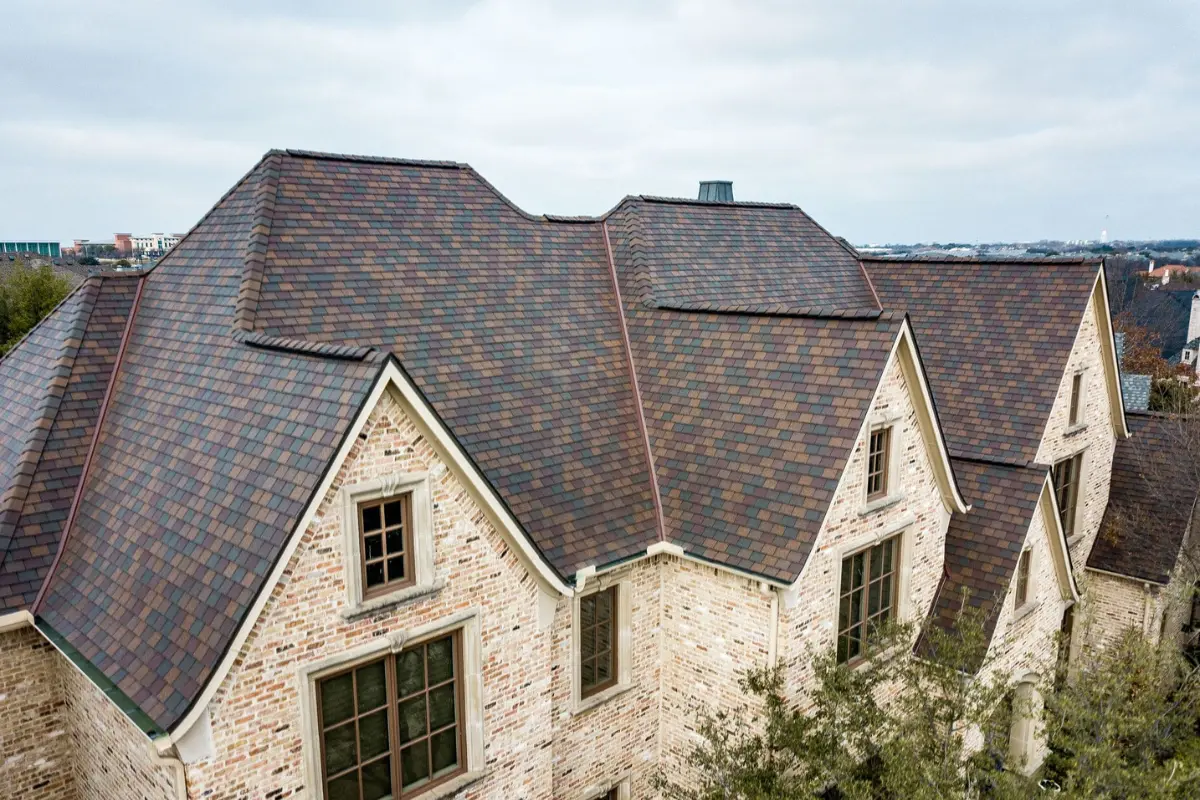
Stone Oak custom home with a newly installed engineered legacy roofing system.
Travis County · Roofing knowledge center

The Complete Roofing Guide for Austin

From Hyde Park bungalows to Zilker moderns to hilltop customs in Westlake — Austin roofs cover more ground than any single guide can flatten. Here's the honest overview.
Local introduction

Roofing in Austin, and why it isn't like anywhere else

Austin's roofing landscape is wider than any other Central Texas market. 1890s Victorians in Hyde Park still have original decking. 1930s cottages in Travis Heights carry period detailing. Post-war ranches in Allandale line block after block. 1980s customs in Northwest Hills sit on hilly lots. Modern glass-and-metal architecture in East Austin and 78704 uses standing seam, TPO, and green roofs. Every era of American residential architecture is represented.

This guide is meant to give you a real overview — the pressures Austin roofs actually face, typical failure modes across housing eras, and how to think about material selection in a city that spans small historic bungalows to modernist statements.

Climate & weather

How Austin weather actually loads your roof

Travis County's Hill Country adjacency, urban heat island, and rapid weather changes create a specific roof profile.

Urban heat island
Central Austin runs measurably hotter than surrounding suburbs. Cool-roof shingles have real value here.
Hill Country wind on west side
Westlake, Rollingwood, and Northwest Hills see meaningful wind on ridge-line lots.
Hail corridor
Travis County sits in the same alley as Hays and Williamson. 1.5"+ events every 2–3 years.
Wildfire risk on west side
Cedar and juniper density on the west side creates ember risk in red-flag conditions.
Freeze events noted post-2021
Uri's damage raised awareness. Ventilation and ice-and-water shield matter.
Foundation cycling on Blackland Prairie clay
East Austin especially. Chimney flashings crack over decades.
Common problems

What we see most often on Austin roofs

Historic bungalow reroofs
1890s–1920s cottages in Hyde Park, Clarksville, and Bouldin Creek with original decking and complex geometry. Preservation-aware work required.
Post-war ranch reroofs at 2nd generation
Allandale, Crestview, and Brentwood ranches with second-generation shingle roofs now aging out.
Cedar shake at end-of-life on hilly west side
Older Westlake customs with cedar shake. Fire risk and end-of-life together demand replacement.
Modern flat/low-slope leaks
East Austin and 78704 modern designs with membrane roofs. TPO seam failures and detailing issues.
Ventilation on 1980s Hill Country customs
Northwest Hills and Westlake customs with cathedral ceilings and inadequate zone-by-zone ventilation.
Hail damage across the city
Standard Central Texas hail issue. Class 4 impact upgrade during reroof is strongly recommended.
Diagnosing something specific? Our roof problem guide walks through leaks, granule loss, sagging, and ventilation failures step by step.
Engineer's perspective

Why roofs actually fail — from a systems point of view

Atrium Roofing is engineer-led. Here's how we think about your roof as a system, not a stack of shingles.

Austin work spans preservation, modernist detailing, and production reroof — no single approach applies.

Match material to era and neighborhood

1890s Hyde Park bungalow gets heritage-color architectural or salvaged metal. Modern East Austin cube gets standing seam or TPO. Westlake custom gets fire-rated tile or metal. Each project starts with what belongs on the house.

Fire and wind on the west side

Class A assemblies with metal drip edges on any west-side cedar-adjacent lot. Enhanced fastening on ridge-line customs.

Ventilation design, not template

Cathedral ceilings, mixed vaulted-and-flat assemblies, and modernist designs each need engineered ventilation.

Repair, replace, or claim

Three paths, and how to know which one fits

Roof Repair
When damage is isolated — a failed pipe boot, a wind-lifted ridge cap, a valley leak on an otherwise healthy Austin roof — a targeted repair is almost always the right call. Expect $400–$2,500 for most residential repairs, with a written scope so you know what's being touched and what's being left alone.
See Austin Roof Repair Options
Roof Replacement
Once a roof is past 18–20 years, has multiple leak points, or shows widespread granule loss and decking softness, a full system replacement wins on cost per year of service. See our full replacement guide.
View the Full Austin Roof Replacement Guide
Storm Damage
Hail, straight-line winds, and tree impact from Central Texas storms may qualify for an insurance-funded replacement. We inspect first, document with photos, and only recommend a claim when damage is genuinely functional — never cosmetic.
Report Austin Roof Storm Damage
Ballpark costs

What roofing actually costs in Austin

Austin pricing varies more than any other Central Texas market. Ranges below cover typical residential; custom modernist and preservation work runs higher. These are ranges based on typical local jobs, and the actual number depends on your roof.

Small repair
$500 – $1,500
Pipe boot, ridge or valley section, small flashing.
Mid repair
$1,500 – $4,500
Chimney reflash, TPO seam repair, valley re-detail.
Architectural reroof (2,200 sq ft roof footprint)
$12,600 – $16,000
GAF or OC architectural, full tearoff.
Class 4 impact reroof
$14,600 – $18,600
Malarkey Legacy. Insurance discount.
Standing seam metal
$21,300 – $34,600
Common on modern East Austin and west-side customs.
TPO or modified bitumen (low-slope)
$14 – $22 / sq ft
Modern flat and low-slope designs.
Historic preservation reroof
Highly variable
Site visit required. Slate, tile, or heritage material work.
Concrete or clay tile
Quoted after inspection
Mediterranean and Spanish revival customs.
How much would a new roof cost in Austin?
Get an instant estimate
What moves the number
  • Neighborhood and era.
  • Roof complexity and pitch.
  • Historic or modernist detailing.
  • West-side fire and wind exposure.
  • HOA requirements.
  • Access on tight urban lots.
For a full breakdown by material, layer, and roof complexity, see the Central Texas roof cost guide. Compare shingles vs. metal vs. tile side by side in our materials comparison.
Financing

Paying for a roof without draining savings

Austin financing runs the full range — 0% APR bridges for insurance jobs, 60–120 month low-APR loans for retail replacements, and cash for high-end modernist work. Metal and tile reroofs on customs commonly use 10-year financing.

Wind/hail deductibles here run 1–2% of dwelling. Financing the deductible against insurance funding is standard.

Full terms and monthly payment calculators live on our financing page. If a storm was involved, our insurance guide explains how deductibles and depreciation actually work.
Recommended systems

Roof systems that hold up in Austin

These aren't the cheapest options — they're the ones that actually make it to their warranty on Central Texas roofs.

Malarkey Legacy (Class 4)
Best asphalt for hail corridor. Insurance discount.
Standing seam Galvalume
Modern architecture default. Fire and wind performance for west side.
GAF Timberline HDZ with StainGuard Plus
Solid architectural option; StainGuard for shaded urban lots.
TPO or modified bitumen for low-slope
Non-negotiable on flat and low-slope modern designs.
Class A assembly on west-side lots
Fire mitigation baseline in wildfire corridor.
Historic-appropriate materials
Slate, tile, or heritage architectural on preservation homes.
Neighborhoods

Roof characteristics by Austin neighborhood

Housing stock, roof age, and the failure modes we see most often, block by block.

1890s–1930s
Hyde Park & North University
Historic Victorian and Craftsman homes. Preservation-aware work required. Complex geometry, original decking often present.
1900s–1940s + modern infill
Travis Heights & Bouldin Creek
Original bungalows next to modern remodels. Range of roof approaches.
1890s–1930s
Clarksville & Old West Austin
Historic district. Preservation review may apply.
1940s–1960s
Allandale, Crestview, Brentwood
Post-war ranch belt. Second-generation reroofs current.
1930s–2020s
78704 (Zilker, Barton Hills)
Wide mix. Modern remodels use standing seam, TPO, and green roofs.
1920s–2020s
East Austin (Cherrywood, MLK, Chestnut)
Historic small homes with rapid modern infill. Standing seam popular on new builds.
1960s–2020s
Westlake, Rollingwood, West Lake Hills
Hilly custom homes with fire and wind exposure. Metal and tile common.
1970s–2010s
Northwest Hills, Great Hills, Steiner Ranch
Established custom neighborhoods on ridge-line and hillside lots.
1990s–2010s
Circle C, Shady Hollow, Slaughter Lane
Production and semi-custom subdivisions. Second-generation reroofs current.
2000s–2020s
Mueller & new East Austin developments
Modern master-planned communities. Standing seam and TPO common on contemporary designs.
Local context

Around Austin

A little context helps calibrate what a roof in this specific community faces.

Austin's roofing map roughly follows its geography — the Capitol and UT anchor the central core; the Colorado River and Lady Bird Lake divide north from south; MoPac and I-35 separate east from west. The Barton Springs area, Zilker Park, and South Congress mark the character of the 78704. Hyde Park and North University hold the oldest continuously-occupied residential neighborhoods. The Domain and North Austin tech corridor mark newer development. Out west, the terrain rises into the Balcones Escarpment through Westlake and toward Bee Cave; out east, the flatter Blackland Prairie stretches toward Manor and Elgin. Every quadrant has its own roofing conversation, and Austin's growth has ensured all of them are active at once.
Verified reviews

What homeowners actually say

Published, verifiable reviews from third-party platforms — not marketing copy.

4.9★ · 290+ Google Reviews · 60+ Yelp Reviews · 29 Verified GuildQuality Reviews · A+ Rated by BBB · 100% Would Recommend
"Atrium Roofing was very professional. I did my own research, and that's why I chose them. I talked to the owner, Jose, and he was very professional. I liked how they did business. They are a good, respectable business."
Ray J.
San Antonio, TX
Verified · GuildQuality
"Efficient estimate, provided support and guidance in understanding the roofing and insurance process."
Susan L.
San Antonio, TX
Verified · GuildQuality
"Great experience, from start to finish. Owner did 3 onsite visits. The General Manager made an onsite visit. The owner worked with my insurance adjuster directly. Always available to answer questions. He was very knowledgeable and patient with ALL of my many questions. The roofers even showed up a little early. Kept the area clean and, poof, they were done. Excellent. Would highly recommend."
Cheryl D.
San Antonio, TX
Verified · GuildQuality
Frequently asked

Austin homeowner questions

Wider material range, more modern architecture with flat/low-slope, more wildfire exposure on the west side, more urban heat island effect.

Yes if structurally viable. Preservation-appropriate work maintains value in this market.

In this hail corridor, yes. Insurance discount plus real hail resistance.

Real. Class A assemblies and defensible space matter for any Westlake, Rollingwood, or Northwest Hills lot near cedar breaks.

Yes on properly engineered assemblies. Structural and drainage review required. Growing option in East Austin and 78704 modernist builds.

20–25 years on 60-mil TPO with heat-welded seams. Longer on 80-mil.

Usually seam or detailing failures at edges and penetrations. Membrane itself rarely fails first.

Yes. DaVinci or Brava composite preserves aesthetic with Class A fire rating.

Yes and it's popular. Coordinate with reroof if roof is aging.

Varies enormously by neighborhood. Preservation districts have strict requirements; production subdivisions have color and material lists; some East Austin neighborhoods have no HOA at all.

Yes for full replacements within city limits. Historic districts add review layers.

One year from date of loss to file. Complex Austin roofs may have damage not ground-visible; schedule proactive inspections.

Local permanent address, RCAT and manufacturer certifications, insurance certificates, references you can visit, and portfolio matching the type of work you need (historic, modern, or production).

Yes. Never sign with a door-knocker.

Yes. Range from 1 day (small production) to 3 weeks (slate preservation).

Manufacturer system warranty in writing with your name. Certified installer program required. Underneath that sits Atrium's own written 10-year workmanship warranty on the roof replacement itself, non-prorated and fully transferable.

Yes, once. Real selling point in Austin market.

On modern architecture and hilltop customs, yes. On historic homes, only when era-appropriate.

Highly variable. 4–20 sheets depending on age and prior conditions.

Common on high-end historic and modernist work. Lasts essentially forever; premium cost.

Yes on any 15+ year old East Austin home over Blackland Prairie clay. Reflashing during reroof is standard.

On any pre-2000 Austin home with box vents or turbines, yes. Continuous soffit intake plus ridge vent.

Recommended on tall or exposed structures — hilltop customs and any structure with a tall chimney.

Multiple itemized quotes, verify certifications, HOA and preservation pre-approval, financing options, and 30–90 day timeline from decision to install.
Have a specific Austin roof question?

Send a photo or address — we'll respond with an honest assessment, whether that's monitor, repair, or replace.