
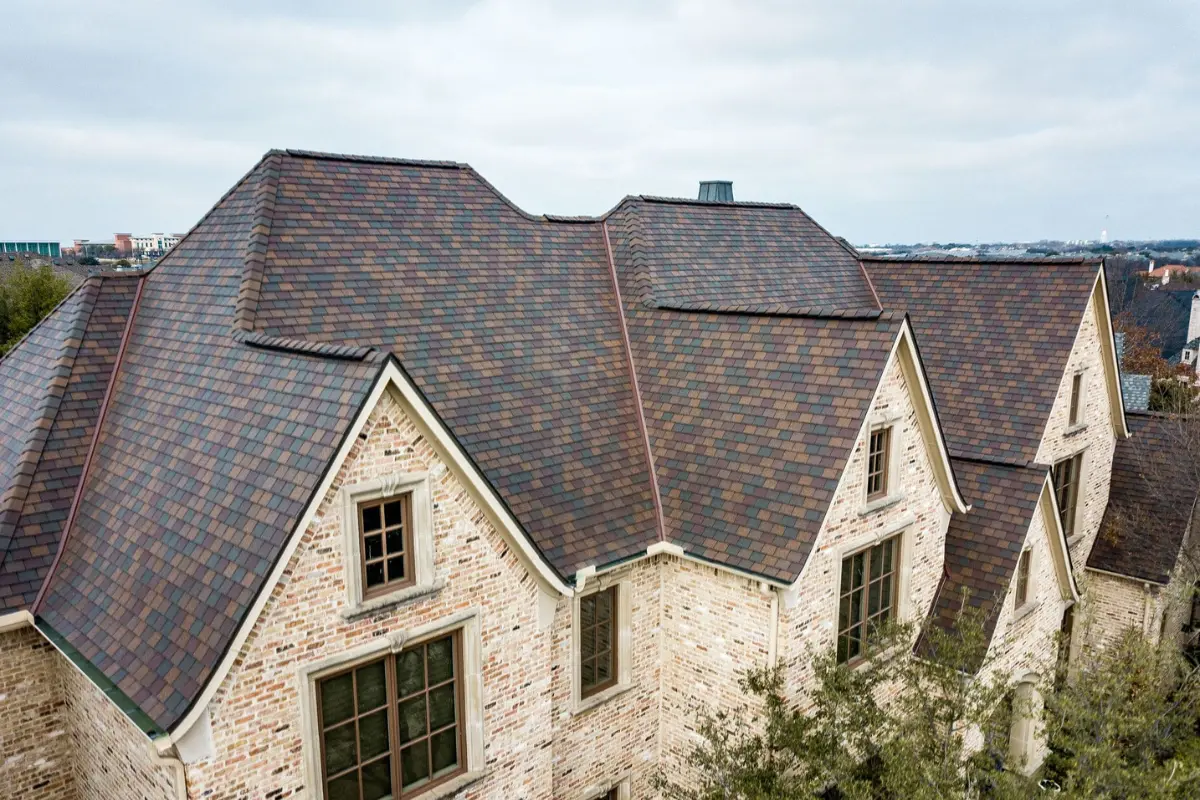
Standing seam metal roof installed on a two-story San Antonio home under blue Texas sky.
Hays County · Roofing knowledge center

The Complete Roofing Guide for Buda

Small-town character with fast subdivision growth. Buda roofs mostly age on the same clock as Kyle — this guide is written for that reality.
Local introduction

Roofing in Buda, and why it isn't like anywhere else

Buda sits north of Kyle along the I-35 corridor and shares much of the same growth story — rapid subdivision development from the 2000s onward, layered over a small historic downtown. Roofing here follows the same pattern: builder-grade production shingles installed to production standards, now aging into their replacement window across most of the city.

What differentiates Buda is the older downtown and the mix of custom builds on the west side toward FM 967. The heritage core needs preservation-aware work; the subdivisions need corrective reroofs.

Climate & weather

How Buda weather actually loads your roof

Same Hays County climate as Kyle, with meaningful wind on the open I-35 corridor.

Direct UV on subdivision lots
Minimal mature canopy on newer development. High UV load.
I-35 corridor wind
Open flat terrain. Ridge and edge failures common.
Hail alley
Same corridor as Kyle and Austin. 1.5"+ events every 2–3 years.
Summer attic temperatures
Code-minimum ventilation on production homes. 140°F attic temps common.
Occasional freeze
Same post-2021 awareness. Ventilation matters for winter moisture too.
Foundation cycling on clay
Chimney flashings crack on 15+ year old homes.
Common problems

What we see most often on Buda roofs

Builder-grade shingles at end-of-life
Production stock from mid-2000s through 2010s failing on the same 12–15 year timeline as neighboring Kyle.
Improper field shingle nailing
Rushed production installs miss the nailing strip. Wind blow-off follows.
Ventilation undersized for roof volume
2-story Buda production homes with steep pitches and code-minimum vents.
Historic downtown chimney flashings
1890s–1920s downtown homes with rusted step flashings.
Pipe boot failure at 7–10 years
Standard Central Texas pattern.
Ridge cap blow-off after storms
Enhanced fastening on reroofs solves it.
Diagnosing something specific? Our roof problem guide walks through leaks, granule loss, sagging, and ventilation failures step by step.
Engineer's perspective

Why roofs actually fail — from a systems point of view

Atrium Roofing is engineer-led. Here's how we think about your roof as a system, not a stack of shingles.

Buda reroof approach mirrors Kyle — correct production shortcuts, redesign ventilation, and use enhanced edge details for corridor wind.

Two-track approach

Subdivision homes get a corrective reroof playbook. Downtown historic homes get preservation-aware scope with era-appropriate materials.

Ventilation is standard scope

Continuous soffit intake plus ridge vent on every pre-2015 reroof. Non-negotiable.

Enhanced edges for corridor wind

Starter strips along every rake and hand-sealed ridge caps on any open-lot Buda home.

Repair, replace, or claim

Three paths, and how to know which one fits

Roof Repair
When damage is isolated — a failed pipe boot, a wind-lifted ridge cap, a valley leak on an otherwise healthy Buda roof — a targeted repair is almost always the right call. Expect $400–$2,500 for most residential repairs, with a written scope so you know what's being touched and what's being left alone.
See Buda Roof Repair Options
Roof Replacement
Once a roof is past 18–20 years, has multiple leak points, or shows widespread granule loss and decking softness, a full system replacement wins on cost per year of service. See our full replacement guide.
View the Full Buda Roof Replacement Guide
Storm Damage
Hail, straight-line winds, and tree impact from Central Texas storms may qualify for an insurance-funded replacement. We inspect first, document with photos, and only recommend a claim when damage is genuinely functional — never cosmetic.
Report Buda Roof Storm Damage
Ballpark costs

What roofing actually costs in Buda

Buda pricing tracks Kyle closely for equivalent production homes. Historic downtown work runs higher. These are ranges based on typical local jobs, and the actual number depends on your roof.

Small repair
$425 – $1,150
Pipe boot, ridge cap, small flashing.
Mid repair
$1,150 – $3,300
Chimney reflash, valley re-detail.
Architectural reroof (2,200 sq ft roof footprint)
$12,600 – $16,000
GAF or OC architectural, full tearoff, ventilation redesign.
Class 4 impact reroof
$14,600 – $18,600
Malarkey Legacy. Insurance discount.
Standing seam metal
$21,300 – $34,600
Common on west-side customs.
Historic downtown reroof
Highly variable
Preservation-aware scope. Site visit required.
How much would a new roof cost in Buda?
Get an instant estimate
What moves the number
  • Historic vs. production.
  • Roof size and complexity.
  • Ventilation scope.
  • HOA requirements.
  • Access.
  • Decking condition.
For a full breakdown by material, layer, and roof complexity, see the Central Texas roof cost guide. Compare shingles vs. metal vs. tile side by side in our materials comparison.
Financing

Paying for a roof without draining savings

Standard 60–120 month terms for most Buda replacements. Insurance-funded jobs use 0% APR bridges.

Wind/hail deductibles run 1–2% of dwelling — typically $3,000–$6,000. Financing the deductible is standard.

Full terms and monthly payment calculators live on our financing page. If a storm was involved, our insurance guide explains how deductibles and depreciation actually work.
Recommended systems

Roof systems that hold up in Buda

These aren't the cheapest options — they're the ones that actually make it to their warranty on Central Texas roofs.

Malarkey Legacy (Class 4)
Hail resistance plus insurance discount.
GAF Timberline HDZ with LayerLock
Wind performance for open corridor lots.
Standing seam Galvalume
West-side custom builds and modern farmhouses.
Enhanced ventilation retrofit
Universal need on pre-2015 Buda stock.
Heritage-color architectural on historic homes
Preservation-aware color and profile matching.
Neighborhoods

Roof characteristics by Buda neighborhood

Housing stock, roof age, and the failure modes we see most often, block by block.

2000s–2010s
Whispering Hollow
Large Buda subdivision. Original 25-year shingles at end-of-life now.
2000s–2010s
Elm Grove
Similar production stock.
2010s–2020s
Shadow Creek
Newer production. Original roofs still within service life.
1890s–1960s
Old Buda residential
Small historic downtown and adjacent residential. Preservation-aware work.
2000s–2010s
Bradfield Village & Garlic Creek
Mid-size production. Reroof window approaching.
2010s–2020s
West-side FM 967 area
Semi-custom and custom builds on larger lots.
Local context

Around Buda

A little context helps calibrate what a roof in this specific community faces.

Buda's downtown square along Main Street preserves 1880s–1920s character with the old Buda Mercantile building as an anchor. Buda City Park and the annual Wiener Dog Races give the town its identity. I-35 divides commercial development on the east from residential neighborhoods spreading west. FM 967 leads toward Driftwood and the Salt Lick country. The Hays CISD school footprint has grown along with residential development, and each new elementary marks another wave of subdivision buildout.
Verified reviews

What homeowners actually say

Published, verifiable reviews from third-party platforms — not marketing copy.

4.9★ · 290+ Google Reviews · 60+ Yelp Reviews · 29 Verified GuildQuality Reviews · A+ Rated by BBB · 100% Would Recommend
"Atrium Roofing was very professional. I did my own research, and that's why I chose them. I talked to the owner, Jose, and he was very professional. I liked how they did business. They are a good, respectable business."
Ray J.
San Antonio, TX
Verified · GuildQuality
"Efficient estimate, provided support and guidance in understanding the roofing and insurance process."
Susan L.
San Antonio, TX
Verified · GuildQuality
"Great experience, from start to finish. Owner did 3 onsite visits. The General Manager made an onsite visit. The owner worked with my insurance adjuster directly. Always available to answer questions. He was very knowledgeable and patient with ALL of my many questions. The roofers even showed up a little early. Kept the area clean and, poof, they were done. Excellent. Would highly recommend."
Cheryl D.
San Antonio, TX
Verified · GuildQuality
Frequently asked

Buda homeowner questions

Same reason as Kyle — builder-grade production shingles with inadequate ventilation don't achieve their printed life in this exposure.

17–20 years on architectural asphalt with proper ventilation.

In this hail corridor, yes.

Continuous soffit intake plus properly sized ridge vent.

4–10 sheets typical on production homes.

Yes. Most Buda homes finish in 1–2 days.

Manufacturer system warranty in writing with your name. Certified installer program. Underneath that sits Atrium's own written 10-year workmanship warranty on the roof replacement itself, non-prorated and fully transferable.

Yes, once.

Most Buda HOAs do. Verify before ordering.

Yes. Never sign with a door-knocker.

Local permanent address, certifications, references.

One year from date of loss.

Yes for full replacements. Contractor handles.

4–8 weeks typical.

Yes if roof has 10+ years remaining.

$700–$2,000.

Yes. 60–120 months.

Yes — preservation-aware scope. Different from production reroof.

Yes — lead or high-grade replaces standard rubber. Extends leak-free life significantly.

$800–$2,000.

Weathered wood, driftwood, charcoal, slate commonly approved.

On modern-farmhouse and contemporary customs, yes. On production, Class 4 shingle usually wins on cost.
Have a specific Buda roof question?

Send a photo or address — we'll respond with an honest assessment, whether that's monitor, repair, or replace.