
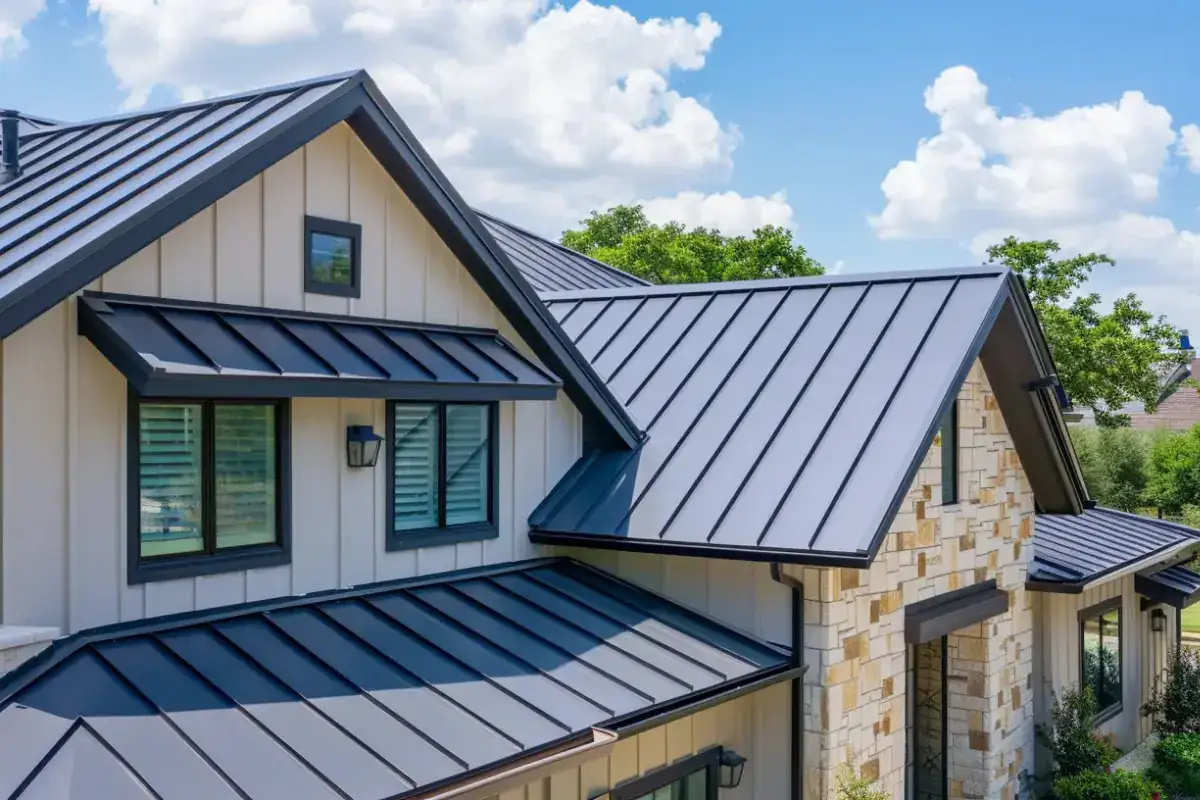
Atrium Roofing crew installing an engineer-led roofing system on a San Antonio residence.
Bexar County · Roofing knowledge center

The Complete Roofing Guide for San Antonio

Everything a San Antonio homeowner should understand about their roof — how the city's heat, hail, and older housing stock actually shape what fails, what lasts, and what a fair quote looks like.
Local introduction

Roofing in San Antonio, and why it isn't like anywhere else

San Antonio is one of the hardest cities in Texas to keep a roof healthy in, and most homeowners don't find that out until year twelve. Between the sustained 100°F summer surface temperatures on south-facing slopes, the spring hail corridor that runs right through Bexar County, and a housing stock that spans everything from 1920s bungalows in Monte Vista to 2020s stucco production homes out past Loop 1604, "a roof in San Antonio" isn't one thing — it's five or six different problems depending on where you live and when your house was built.

The average asphalt shingle roof here lasts 15–18 years, not the 25–30 printed on the wrapper. UV intensity at 29.4°N latitude, combined with attic temperatures that regularly break 140°F in July and August, cooks the asphalt binder from below while the sun oxidizes the granules from above. That's before a single hailstone touches it.

This guide is written for the homeowner who wants to understand what they're looking at — not to be sold. If after reading it you never call us, we still consider it a win. San Antonio has enough pressure sales in roofing already.

Climate & weather

How San Antonio weather actually loads your roof

San Antonio sits at the intersection of Gulf humidity, Hill Country wind, and the Texas hail alley — a rougher climate for asphalt shingles than most homeowners realize.

Extreme UV load
San Antonio averages 220+ sunny days per year. UV degrades the polymer binder in asphalt shingles from the surface down, causing granule loss long before the mat fails.
140°F attic temperatures
Without balanced ridge-and-soffit ventilation, attic temperatures in July cook shingles from underneath. Most warranty voids we see cite inadequate ventilation.
Hail alley
Bexar County averages 2–4 significant hail events per year, mostly March through May. Damage runs from cosmetic dimpling to functional mat fracture at 1.5" and above.
Straight-line wind
Springtime derechos regularly push 60–75 mph winds across the city. Ridge caps, drip edge, and improperly nailed field shingles are the first to lift.
Sudden monsoon rain
2–4 inch rainfall in under an hour is routine in September. Undersized valleys and clogged gutters back water up under shingle courses within minutes.
Foundation movement
Expansive clay soil across most of the city cycles wet and dry, cracking flashings around chimneys and dormers as the house shifts a quarter inch year to year.
Common problems

What we see most often on San Antonio roofs

Builder-grade 3-tab failure at 12–14 years
Vast tracts of 1990s–2005 subdivisions (Great Northwest, Alamo Ranch phase 1, Timberwood Park) were shingled with 20-year 3-tabs. Almost all of them are past service life. Granule shed in gutters is the first sign.
Pipe boot cracking on southern exposures
Rubber pipe boots facing south fail in 7–10 years under San Antonio sun. This is the #1 source of leaks we chase in otherwise-healthy roofs, especially over master bathrooms.
Ridge cap blow-off after spring storms
Improperly hand-nailed ridge caps lift in 55+ mph gusts. If you see dark strips along your ridge line after a storm, that's exposed underlayment.
Chimney flashing failures on 1970s–80s homes
Homes in Terrell Hills, Alamo Heights, and older Northwood-era Castle Hills often have reused step flashings from a prior reroof. They're rusted through and leaking behind the siding.
Attic condensation misread as leak
Ceiling stains that appear in January, not July, are usually poor ventilation — not a roof leak. Adding baffles and a ridge vent solves it without touching shingles.
Squirrel and raccoon entry at soffit returns
Older Olmos Park, Terrell Heights, and Mahncke Park homes have soffit returns that gap over time. Wildlife gets in, chews wiring, and homeowners find out via a leak that isn't a leak.
Diagnosing something specific? Our roof problem guide walks through leaks, granule loss, sagging, and ventilation failures step by step.
Engineer's perspective

Why roofs actually fail — from a systems point of view

Atrium Roofing is engineer-led. Here's how we think about your roof as a system, not a stack of shingles.

We think about a San Antonio roof as a five-layer water management system, not a shingle color. When the system works, water moves outward and downward on every surface, at every transition, under every condition. When it fails, it's almost never the shingle itself — it's a detail at a transition where two materials meet.

Load path first, aesthetics second

Every fastener has a job. Nail placement on the shingle nailing strip matters more than the nail gun's brand. High-nailed shingles pass inspection and blow off two springs later when a 65 mph wind lifts under the tab. On San Antonio production homes we regularly find every third or fourth shingle nailed above the strip.

Ventilation is a design decision, not an upgrade

A balanced attic needs one square foot of net free ventilation area per 300 square feet of attic floor, split evenly between intake (soffit) and exhaust (ridge). Most 1990s San Antonio homes were built with turbine or box vents and no soffit intake at all. That's why their shingles fail early and their attics smell like a car in July.

Flashings are the roof

On the vast majority of leak calls we run in the 78209 and 78216 ZIP codes, the shingles are fine. The step flashing at a wall, the counter-flashing on a chimney, or the boot around a plumbing vent is the actual failure. We replace flashings during any reroof — we don't reuse them. That single practice eliminates 70% of post-install leak calls.

Repair, replace, or claim

Three paths, and how to know which one fits

Roof Repair
When damage is isolated — a failed pipe boot, a wind-lifted ridge cap, a valley leak on an otherwise healthy San Antonio roof — a targeted repair is almost always the right call. Expect $400–$2,500 for most residential repairs, with a written scope so you know what's being touched and what's being left alone.
See San Antonio Roof Repair Options
Roof Replacement
Once a roof is past 18–20 years, has multiple leak points, or shows widespread granule loss and decking softness, a full system replacement wins on cost per year of service. See our full replacement guide.
View the Full San Antonio Roof Replacement Guide
Storm Damage
Hail, straight-line winds, and tree impact from Central Texas storms may qualify for an insurance-funded replacement. We inspect first, document with photos, and only recommend a claim when damage is genuinely functional — never cosmetic.
Report San Antonio Roof Storm Damage
Ballpark costs

What roofing actually costs in San Antonio

Ranges below reflect real 2026 San Antonio pricing for a typical single-story 2,000 sq ft home with a 6/12 pitch and standard accessibility. Complex roofs run higher. These are ranges based on typical local jobs, and the actual number depends on your roof.

Small repair
$450 – $1,200
Pipe boot, valley patch, ridge cap replacement, or single-slope shingle repair.
Mid repair
$1,200 – $3,500
Chimney reflash, multi-penetration repair, decking replacement in a small area.
Architectural reroof
$13,800 – $17,400
GAF Timberline HDZ or Owens Corning Duration on a 2,000 sq ft ranch, full tearoff, new synthetic underlayment, all new flashings.
Class 4 impact reroof
$16,000 – $20,300
Malarkey Legacy or GAF Grand Sequoia IR. Qualifies for insurance discounts in most Texas policies.
Standing seam metal
$23,200 – $37,800
24-gauge Galvalume with concealed fasteners. 40–60 year service life on Central Texas exposures.
Concrete or clay tile
Quoted after inspection
Common in Dominion, Stone Oak, and Sonterra. Structural analysis required if converting from shingle.
How much would a new roof cost in San Antonio?
Get an instant estimate
What moves the number
  • Roof pitch: 8/12 and steeper adds 15–30% labor. Anything walkable (below 7/12) is baseline.
  • Number of stories and accessibility (trees, tight backyards, no truck access).
  • Decking condition after tearoff — soft OSB or delaminated plywood is common on 1990s builds.
  • Valley count and penetration count. Cut-up roofs cost significantly more per square.
  • Ventilation upgrades (adding soffit vents, replacing box vents with ridge vent).
  • Whether the insurance carrier is paying replacement cost value (RCV) or actual cash value (ACV).
For a full breakdown by material, layer, and roof complexity, see the Central Texas roof cost guide. Compare shingles vs. metal vs. tile side by side in our materials comparison.
Financing

Paying for a roof without draining savings

Most San Antonio homeowners we work with don't pay cash for a new roof. The two paths that make sense here are (1) 0% APR for 12–18 months for storm-damage jobs where the insurance check funds most of the balance and the deductible is the only real out-of-pocket, and (2) a longer 84–120 month low-APR loan for full retail replacements where the monthly payment lands close to what a second HVAC service call would cost.

Deductibles on Bexar County wind/hail policies commonly run 1–2% of dwelling coverage — on a $400,000 home that's $4,000–$8,000. Financing that deductible while the carrier funds the roof is a common and reasonable move. Financing the whole replacement out-of-pocket is worth doing only when the monthly payment is genuinely something you'd forget about — not something you'd feel.

Full terms and monthly payment calculators live on our financing page. If a storm was involved, our insurance guide explains how deductibles and depreciation actually work.
Recommended systems

Roof systems that hold up in San Antonio

These aren't the cheapest options — they're the ones that actually make it to their warranty on Central Texas roofs.

GAF Timberline HDZ with StainGuard Plus
The default we recommend for most 78230/78248/78250 homes. Class 3 impact and StainGuard Plus algae protection against the streaks common on north-facing San Antonio slopes. On GAF systems we register the GAF Silver Pledge.
Malarkey Legacy (Class 4)
Polymer-modified asphalt that flexes instead of cracking under hail. Qualifies for the Texas insurance impact-resistant discount, which pays back the upgrade in 5–7 years for most Bexar County homes.
Standing seam Galvalume metal
For Hill Country-edge properties (Cross Mountain, Grey Forest, north Helotes) where wildfire risk and thermal expansion both matter. 24-gauge with a Kynar 500 finish holds color for 30+ years in San Antonio UV.
Concrete tile (Boral, Eagle)
The right call for Mediterranean and Spanish revival architecture in The Dominion and Sonterra when the trusses are engineered for it. 50+ year field life if flashings are maintained.
Enhanced ventilation retrofit
On many older homes the biggest upgrade isn't the shingle — it's adding continuous soffit intake and a ridge vent. Drops attic temperatures 15–25°F and extends the next shingle's life by years.
Neighborhoods

Roof characteristics by San Antonio neighborhood

Housing stock, roof age, and the failure modes we see most often, block by block.

1920s–1950s
Alamo Heights & Olmos Park
Original slate, tile, and cedar shake roofs long since converted to composition. Complex hip-and-valley geometry, steep pitches, chimneys everywhere. Almost every reroof here uncovers rotted decking and reused flashings from a prior job.
1930s–1950s
Terrell Hills & Mahncke Park
Small footprint, steep gables, and detailed dormers. Fascia and soffit rot is common. Ventilation is almost always undersized — most attics have gable vents only.
1900s–1930s
Monte Vista
Historic district with review requirements. Materials must match — usually 30-year architectural shingle in a heritage color, or a full return to slate/tile where original.
1990s–2010s
Stone Oak & Sonterra
Large 2-story production homes with cut-up rooflines and multiple valleys. Concrete tile is common; when shingles are used, ventilation is almost always inadequate for the roof volume.
1980s–2020s
The Dominion
Custom estates with tile, slate, and standing seam. Copper valleys and gutters are common. Warranty transfers matter here — buyers ask.
2000s–2020s
Alamo Ranch & Westover Hills
Production builds with builder-grade 25-year shingles installed with 4 nails per shingle. Wind blow-off calls after every spring storm. Most are due for a full replacement between years 14–17.
1980s–1990s
Great Northwest & Timberwood Park
Mature trees mean shade (good) and constant debris (bad). Valleys and gutters silt up quickly. Squirrel activity at soffit gaps is a persistent problem.
1940s–1970s
Southside (Highland Park, Mission San Jose area)
Small ranch and mid-century homes, often with room additions that create odd roof transitions. Those transitions are where 90% of leaks originate.
Local context

Around San Antonio

A little context helps calibrate what a roof in this specific community faces.

San Antonio's rooftop character is easier to read once you know where you're standing. Drive north from downtown through Monte Vista and Alamo Heights and you'll see century-old slate and clay tile still holding in place beside 1920s bungalows on Broadway. Head west toward UTSA and Loop 1604 and the housing stock flips to 1990s and 2000s production, block after block of architectural asphalt. The medical center at Fredericksburg Road sits at the transition — smaller ranches south, larger two-story production north. Out past the AT&T Center on the east side and Highway 90 on the south, you're back into mid-century ranches with room additions and complicated transition details. Down by the River Walk and King William, tile and standing seam dominate because the architecture demands it. None of that changes the physics of a roof — but it does change what a fair scope of work looks like on your specific house.
Verified reviews

What homeowners actually say

Published, verifiable reviews from third-party platforms — not marketing copy.

4.9★ · 290+ Google Reviews · 60+ Yelp Reviews · 29 Verified GuildQuality Reviews · A+ Rated by BBB · 100% Would Recommend
"Atrium Roofing was very professional. I did my own research, and that's why I chose them. I talked to the owner, Jose, and he was very professional. I liked how they did business. They are a good, respectable business."
Ray J.
San Antonio, TX
Verified · GuildQuality
"Efficient estimate, provided support and guidance in understanding the roofing and insurance process."
Susan L.
San Antonio, TX
Verified · GuildQuality
"Great experience, from start to finish. Owner did 3 onsite visits. The General Manager made an onsite visit. The owner worked with my insurance adjuster directly. Always available to answer questions. He was very knowledgeable and patient with ALL of my many questions. The roofers even showed up a little early. Kept the area clean and, poof, they were done. Excellent. Would highly recommend."
Cheryl D.
San Antonio, TX
Verified · GuildQuality
Frequently asked

San Antonio homeowner questions

Realistically 15–18 years for architectural shingles, 10–14 for 3-tabs. Manufacturer warranties assume ideal ventilation and moderate climate — neither of which San Antonio provides. Class 4 impact shingles in a well-ventilated attic can push 22–25 years.

It's algae — specifically Gloeocapsa magma. It's cosmetic, not structural, but it's a good indicator that granule cover is thinning. Algae grows on partially exposed asphalt, not fresh granules.

Only where it's soft, delaminated, or fastener-stripped. We inspect every board once the shingles are off and you approve any decking replacement before it's installed. On 1990s San Antonio builds we typically replace 4–12 sheets.

Functional damage — bruised mat, fractured granules, exposed asphalt — in more than 8–10 hits per test square is the general adjuster threshold. Cosmetic dimpling on soft metal alone won't get a claim paid on the shingles.

Only if the roof has 12+ years of service life remaining. Otherwise you'll pay $2,000–$4,000 to remove and reinstall panels during a replacement 5 years later. Reroof first, then panel — the math always favors it.

Not on a modern install with a solid deck and synthetic underlayment. The old barn-metal-on-purlins sound doesn't apply. Standing seam on a residential deck sounds about the same as asphalt from inside the house.

Texas Insurance Code Chapter 542A requires you to file within one year of the date of loss for most residential policies. Wait longer and the carrier can deny the claim outright — even if the damage is real.

Inside city limits, yes, for full replacement. Most repairs under a threshold don't. Your contractor pulls it. Anyone quoting a full reroof "without a permit to save you money" is a red flag.

Storm-chasing crews follow hail events across the country. They knock doors, promise to "waive your deductible" (illegal in Texas), and disappear before warranty claims. Use a locally-based contractor with a permanent San Antonio address you can drive to.

There is no free roof. Anyone offering one is either committing insurance fraud (waiving your deductible) or padding the claim. Both get you into legal trouble. Pay your deductible; that's the deal you have with your carrier.

Yes for experienced crews with harnesses. 8/12 and steeper we always work roped and staged, which adds labor cost. Anything above 10/12 in San Antonio is usually a Tudor or Victorian gable and requires specialty pricing.

Most single-story homes finish in one day. Two-story production homes take two. Steep or complex roofs (Alamo Heights, Dominion) can run three to four. We schedule around forecast, never during rain.

October through February is ideal — cooler crews work faster, sealant activates properly above 45°F. Summer installs are fine but we start at sunrise to beat the heat.

Yes. We meet the adjuster on the roof, walk the damage together, and provide photos and measurements. We can't legally negotiate for you (that's public adjusting), but presence and documentation dramatically improve approval rates.

Not directly from a single weather-related claim on most Texas policies. Area-wide storm events raise everyone's premium the following renewal regardless of whether you filed. Your neighbor's claim affects your rate more than your own.

A real system warranty from GAF, Owens Corning, or Malarkey requires a certified installer and their full accessory system. It's not the same as "lifetime shingle" printed on a bundle. Ask for it in writing with your name on it. Underneath that sits Atrium's own written 10-year workmanship warranty on the roof replacement itself, non-prorated and fully transferable.

Yes, on flat and low-slope sections — additions, sunrooms, dormer decks. We use 60 mil TPO with heat-welded seams. Never shingle a slope below 2/12; it will leak.

Attic surface temperature should not exceed outdoor ambient by more than 20°F on a summer afternoon. If you can't stand in your attic at 3pm without a heat headache, ventilation is undersized.

Foil-backed decking reflects radiant heat back out of the attic. Meaningful savings on cooling bills in San Antonio (5–10%), but only if attic ventilation is already balanced. Otherwise it traps heat with the underside.

Yes, roughly 8–12°F warmer surface temperature than light-colored equivalents. Cool-roof rated shingles (Owens Corning COOL series) reduce that meaningfully. Whether the aesthetics are worth it is up to you.

If they're 15+ years old, yes — the labor overlap is significant and matching new gutter to old drip edge often creates leaks. 6-inch seamless K-style is the Central Texas standard.

Texas roofing is unlicensed at the state level. Ask for TDI-recognized certifications (RCAT), manufacturer certifications (GAF Certified Plus or higher, OC Preferred), local BBB accreditation, and a permanent San Antonio address. Verify all three yourself.

You may still be within the one-year policy filing window, but evidence gets harder to attribute to the specific storm. File as soon as you find it, with photos and any weather records for the date of loss.

Yes. Expect noise 7am–5pm on install day. Move wall-mounted art away from exterior walls (vibration), and don't park under the roofline. Pets should be inside.

GAF and Owens Corning system warranties transfer once to the next homeowner. That transfer becomes a real selling point — request it in writing during listing.
Have a specific San Antonio roof question?

Send a photo or address — we'll respond with an honest assessment, whether that's monitor, repair, or replace.