
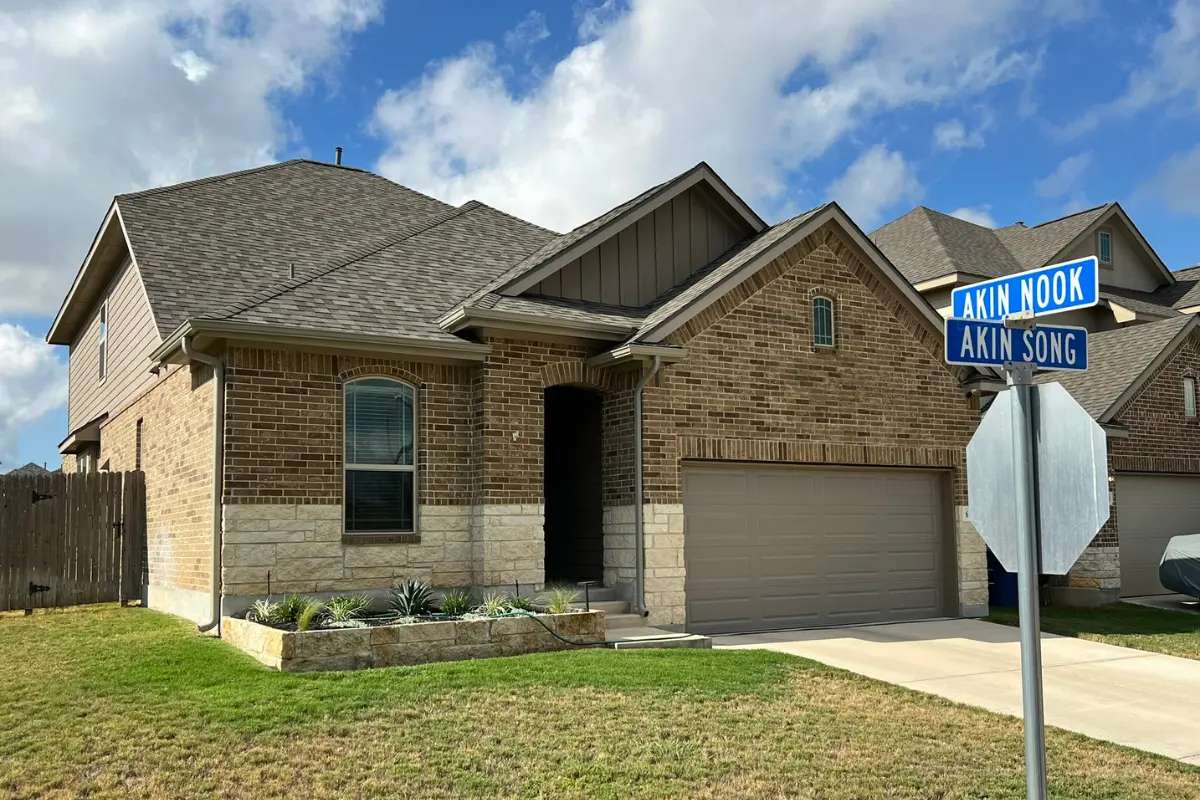
Atrium Roofing crew installing an engineer-led roofing system on a San Antonio residence.
Wilson County · East of San Antonio · Roofing knowledge center

The Complete Roofing Guide for La Vernia

Most people arrive in La Vernia from a San Antonio subdivision, moving for the schools and the land. The house is bigger, the lot is bigger, and nobody is left to tell you when your roof is failing — no HOA, no neighbor's reroof to benchmark against, no city inspector catching a bad install. Here is what changed, and how to find out where you stand.
Local introduction

Roofing in La Vernia, and why it isn't like anywhere else

La Vernia is a small city about 25 miles east of San Antonio on US-87, in Wilson County, in the rural-to-suburban transition zone. Growth here is family-driven and school-driven: people move for La Vernia ISD and for land, typically leaving a quarter-acre subdivision lot for one to five acres with a detached garage, a shop, sometimes a barn, on septic and often on well. That is a genuinely different property to maintain, and the roof is the part most new owners have not thought about yet.

The thing that changes first is who is watching. In a subdivision, an HOA letter, a neighbor reroofing three doors down, and a municipal inspector on the permit all function as an early warning system. On acreage in unincorporated Wilson County, none of that exists. Nobody is going to tell you the roof is failing — you have to know, or you find out when water comes through a ceiling. The second thing that changes is water volume: longer roof runs on a bigger house discharge far more water, and on Wilson County blackland clay, where that water lands is a structural question rather than a landscaping one.

Climate & weather

How La Vernia weather actually loads your roof

Flat, open, and unshaded, over some of the most active clay in the region. Four loads dominate a La Vernia roof.

Severe blackland clay movement
Wilson County clay swells and shrinks dramatically between wet and dry seasons. The slab moves, the chimney moves independently of the roof plane, and rigid flashing joints separate.
Full-day ultraviolet exposure
Newer acreage has very little mature canopy. South and west slopes take an unshaded load all day, oxidizing asphalt and fatiguing sealant strips years before the shaded side.
Unobstructed straight-line wind
Flat open terrain with no upwind windbreak. Thunderstorm outflow arrives at full speed at ridge caps, rake edges, and the eave course.
US-87 corridor hail
Real, recurring hail exposure east of the metro. 1"–2" stones are routine and larger events are on record, which makes impact rating a live specification decision.
High discharge volume on long roof runs
Larger acreage homes shed far more water per storm than a subdivision house, and it all lands somewhere. Concentrated discharge next to a slab on active clay is a foundation problem in slow motion.
Outbuilding exposure
Detached shops, garages, and barns sit fully exposed with their own flashing, edge, and fastener details — and their own, usually shorter, service lives.
Common problems

What we see most often on La Vernia roofs

Chimney and wall-to-roof flashing separation
The leading repair call in La Vernia. Clay movement pulls masonry away from the roof plane, the counter-flashing joint opens, and sealant buys a season before it opens again.
Recurring 'sealed' leaks that keep coming back
A caulk bead over a movement-driven separation is not a repair. The detail has to be rebuilt with proper step and counter-flashing let into the masonry, or you are on an annual leak cycle.
Gutter discharge dumping against the slab
Undersized troughs and downspouts that end at the foundation concentrate a whole roof's water into a few square feet of clay. Differential soil movement follows, and so does the next flashing failure.
Wind-lifted ridge caps and rake edges
Open terrain means full-speed wind at the roof's edges. Corners lift first, and once water gets under the field from the top the failure spreads downward.
Uneven slope aging under full sun
With no canopy, the west slope commonly reaches end of life several years before the north side of the same roof. One roof, two ages.
Neglected detached shops and barns
Exposed-fastener metal backing out, aging low-slope garage roofs, and unflashed lean-to additions. The house gets attention; the outbuildings are usually further gone.
Diagnosing something specific? Our roof problem guide walks through leaks, granule loss, sagging, and ventilation failures step by step.
Engineer's perspective

Why roofs actually fail — from a systems point of view

Atrium Roofing is engineer-led. Here's how we think about your roof as a system, not a stack of shingles.

The most useful thing we can tell a new La Vernia homeowner is that your roof left the managed-maintenance environment when you left the subdivision. That is not a warning about neglect — most of the people we meet here are careful owners. It is that the feedback loop is gone. There is no HOA letter, no visible cadence of neighbors reroofing on the same builder timeline, and on unincorporated property no municipal inspector reviewing the last install. The result is that roofs out here routinely run five to ten years past the point where someone in a subdivision would have been prompted to act.

Establish a baseline in your first year, not your first leak

If you bought the house, you probably do not actually know the roof's age. Get a documented condition baseline: slope-by-slope photographs, decking condition, flashing condition, ventilation math, and a stated remaining service life. That document is what turns a future storm into a defensible insurance conversation instead of an argument about pre-existing wear. It is also, frequently, how we tell someone their roof is fine and to call us in six years.

On this clay, gutter discharge is structural

This is the point subdivision owners find surprising. On a quarter-acre lot with a modest roof, a downspout at the corner is a minor detail. On a 3,000 square foot acreage home, every inch of rain sheds a large volume of water, and dropping it beside a slab sitting on severe blackland clay creates a local wet zone that swells while the rest of the perimeter dries. The slab moves differentially, the chimney tilts relative to the roof, and the flashing you just paid to reseal opens again. We size troughs and downspouts for the actual roof area and route discharge well away from the structure, because that is roof work here.

Rebuild flashing details rather than resealing them

A movement-driven chimney leak will defeat sealant every time. The honest repair is step flashing under the courses, counter-flashing let into a cut reglet in the masonry rather than surface-caulked, and a cricket on the uphill side of any chimney wide enough to trap water and debris. It costs more once and stops the annual cycle.

Scope the outbuildings separately and honestly

A shop, a detached garage, and a barn are three different roofs with three different service lives, and none of them should be quietly folded into a house price. We price them as separate line items so you can defer one and do another, and we will tell you when an outbuilding roof has five good years left and does not need touching.

Repair, replace, or claim

Three paths, and how to know which one fits

Roof Repair
When damage is isolated — a failed pipe boot, a wind-lifted ridge cap, a valley leak on an otherwise healthy La Vernia roof — a targeted repair is almost always the right call. Expect $400–$2,500 for most residential repairs, with a written scope so you know what's being touched and what's being left alone.
See La Vernia Roof Repair Options
Roof Replacement
Once a roof is past 18–20 years, has multiple leak points, or shows widespread granule loss and decking softness, a full system replacement wins on cost per year of service. See our full replacement guide.
View the Full La Vernia Roof Replacement Guide
Storm Damage
Hail, straight-line winds, and tree impact from Central Texas storms may qualify for an insurance-funded replacement. We inspect first, document with photos, and only recommend a claim when damage is genuinely functional — never cosmetic.
Report La Vernia Roof Storm Damage
Ballpark costs

What roofing actually costs in La Vernia

La Vernia prices near the San Antonio metro baseline — it is a short drive from our office, and we do not pretend otherwise. What moves the number is acreage access, roof size, and how many structures are in scope. Ranges are 2026 figures for typical single-family homes. These are ranges based on typical local jobs, and the actual number depends on your roof.

Small repair
$450 – $1,200
Pipe boot replacement, ridge cap section, minor flashing patch, isolated shingle repair.
Mid repair
$1,200 – $3,800
Full chimney reflash with cut reglet counter-flashing and cricket, valley re-detail, wall-to-roof rebuild. This is the common La Vernia call.
Architectural asphalt reroof (2,400 sq ft roof footprint)
$13,800 – $17,400
Full tearoff, synthetic underlayment, all new flashings, balanced ventilation, manufacturer system warranty.
Class 4 impact reroof
$16,000 – $20,300
The right specification on the US-87 hail corridor, with UL 2218 documentation for your carrier discount.
6-inch seamless gutters (full house)
$1,900 – $4,200
Aluminum with correctly spaced 3x4 downspouts and extended discharge routing away from the slab. Repairs typically $300 – $850.
Detached shop, garage, or barn
$3,500 – $18,000+
Scoped and priced as a separate line item, never bundled into the house. Exposed-fastener metal re-screw, panel replacement, or full reroof depending on condition and span.
How much would a new roof cost in La Vernia?
Get an instant estimate
What moves the number
  • Total roof area — acreage homes are commonly larger than the subdivision house you left.
  • Number and condition of outbuildings included in scope.
  • Gate width, driveway length, and equipment staging on acreage.
  • Septic drain field location and required protection during the job.
  • Decking condition, priced per sheet in the contract.
  • Impact rating selection and gutter footage.
For a full breakdown by material, layer, and roof complexity, see the Central Texas roof cost guide. Compare shingles vs. metal vs. tile side by side in our materials comparison.
Financing

Paying for a roof without draining savings

La Vernia replacements are commonly financed over 60–144 months. On acreage properties we will often structure the house and the outbuildings as separate decisions so you can finance the roof that matters now and schedule the shop or barn for a later year rather than borrowing against everything at once.

Wind and hail deductibles in Wilson County commonly run 1–2% of dwelling coverage. On a $400,000 dwelling limit that is $4,000–$8,000 out of pocket on an approved claim, and that figure — not the total job price — is usually what actually needs financing after a storm.

Full terms and monthly payment calculators live on our financing page. If a storm was involved, our insurance guide explains how deductibles and depreciation actually work.
Recommended systems

Roof systems that hold up in La Vernia

These aren't the cheapest options — they're the ones that actually make it to their warranty on Central Texas roofs.

Class 4 impact-rated asphalt (Malarkey Legacy, GAF Armorshield II)
US-87 corridor hail is recurring and real. UL 2218 Class 4 resists functional fracture and earns a carrier discount on the wind and hail portion of the premium.
Rebuilt chimney flashing with cut-reglet counter-flashing and a cricket
The only detail that survives severe blackland clay movement. Surface-caulked counter-flashing reopens within a season or two on Wilson County soil.
6-inch seamless gutters with engineered discharge away from the slab
On a large acreage roof over active clay, discharge placement controls differential soil movement — which controls whether your flashing repair holds.
Balanced ridge-and-soffit ventilation
Full-day unshaded sun drives attic temperatures hard. Correct intake-to-exhaust balance protects shingle service life and keeps summer energy load down.
Synthetic underlayment with ice-and-water membrane in valleys and at wall lines
Wind-driven rain on open terrain reaches places gravity-fed water does not. The membrane is the backup at the details most likely to move.
Neighborhoods

Roof characteristics by La Vernia neighborhood

Housing stock, roof age, and the failure modes we see most often, block by block.

Pre-1970 through 2000s
La Vernia town proper
Older core housing on smaller lots with mature trees, plank decking on the oldest homes, and a mix of first- and second-generation replacements.
1990s–2020s
Cordillera Ranch Estates
Custom acreage homes with cut-up rooflines, multiple valleys, and often a detached shop. Flashing and valley detail is where the scope concentrates.
2000s–2020s
Legacy Ranch
Newer semi-custom homes on larger lots. Builder-grade shingles and marginal ventilation are the recurring findings, with the first replacement wave now arriving.
1990s–2010s
Green Valley
Established acreage properties with roofs commonly at or past 20 years. Chimney and wall flashing separation is the dominant repair call here.
1990s–2020s
Post Oak
Mixed acreage housing with a high share of outbuildings — shops, equipment sheds, and small barns that need separate scoping.
1980s–2020s
FM 775 and FM 1346 corridors
Rural acreage with long driveways, gate access constraints, septic systems, and frequently more than one structure to roof.
1990s–2010s
Sunset Ridge
Open, unshaded lots taking full UV and unobstructed wind. Expect pronounced west-slope aging and wind-lifted edge detail.
Local context

Around La Vernia

A little context helps calibrate what a roof in this specific community faces.

La Vernia sits about 25 miles east of San Antonio on US-87 in Wilson County, close enough that our response time here is genuinely fast — that is a real advantage over our Hill Country markets and we will say so plainly. The town is organized around the US-87 corridor and the La Vernia ISD campuses, which are the reason most families move here. The terrain is flat and open, with blackland clay across the county and little mature canopy on newer acreage. Floresville is south on SH-97 as the Wilson County seat, Seguin is northeast, Cibolo and Universal City are north toward I-35, and San Antonio is a straight run west on US-87.
La Vernia services

Roofing services we deliver in La Vernia, TX

An older town core, newer acreage subdivisions, and rural FM-corridor properties with multiple structures each carry a different scope. We price them that way.

Roof replacement in La Vernia is specified for hail and open-terrain wind: full tearoff, synthetic underlayment, ice-and-water membrane in valleys and at wall lines, all new flashings rather than reused, balanced ridge-and-soffit ventilation, and a manufacturer system warranty registered in your name. On the US-87 corridor we recommend Class 4 impact-rated systems in most cases and explain the carrier discount that comes with them.

Roof repair here is dominated by one detail. Chimney and wall-to-roof flashing separation driven by blackland clay movement is our leading repair call, and it recurs until the detail is rebuilt — step flashing under the courses, counter-flashing let into a cut reglet in the masonry, and a cricket where the chimney is wide enough to trap water. If your roof otherwise has years left, this is the work that keeps it.

Detached shops, garages, and barns are a distinct service line, not an afterthought bundled into a house price. Outbuildings on La Vernia acreage are usually exposed-fastener metal or aging low-slope assemblies with their own service lives. We inspect and price each structure separately — a re-screw with oversized fasteners and new gaskets where the panels are sound and the holes have not elongated, panel replacement where they have, and a full reroof where the assembly is simply finished. You can defer one and do another, and we will tell you when an outbuilding does not need touching.

Septic and well protection during a reroof is part of how we plan an acreage job, and almost nobody brings it up. A dumpster or a loaded material truck parked over a drain field can crush laterals and compact the soil the field depends on, and that repair is far more expensive than the roof. Before we schedule, we ask you to locate the tank and field, then we stage the dumpster and material delivery on the driveway or another approved area, route all traffic clear of the field, and cover the wellhead and exposed plumbing before tearoff begins.

Storm and hail response on the US-87 corridor starts with documentation rather than a claim form. We photograph slope by slope, distinguish functional mat fracture from cosmetic marking, and tell you plainly when there is no claim worth filing. Our hail damage guide explains exactly how that determination is made.

Gutter installation and gutter repair is structural work on this clay. We size 6-inch seamless aluminum troughs to the actual roof area, space 3x4 downspouts correctly for a large acreage roof, and extend discharge well away from the slab so a storm does not create a wet zone against a foundation that is already moving seasonally. Our seamless gutter installation and repair guide covers sizing and discharge in detail.

Ventilation and attic performance work matters under full-day unshaded sun, and builder-grade ventilation on newer acreage homes is frequently under-designed. See our attic ventilation guide for the physics behind balanced intake and exhaust.

Local conditions

How Wilson County conditions actually damage roofs

Severe clay below, unfiltered sun and open wind above, and hail on the corridor. On acreage, water volume ties them together.

Blackland clay movement. Wilson County clay has a high shrink-swell potential, and the seasonal cycle between saturated spring soil and cracked August ground moves the slab measurably. The chimney, being masonry on its own footing, does not move in step with the roof plane. Every rigid joint between them is under repeated strain, and that is why flashing here fails as a pattern rather than as an accident.

Discharge volume on large roofs. This is the part that changes when you leave a subdivision. A 3,000 square foot roof sheds roughly 1,900 gallons in a one-inch rain, and if a downspout drops that at the corner of the slab it saturates one zone while the rest of the perimeter dries. Differential movement follows, and it shows up as the flashing separation above. Sizing and discharge routing are not landscaping decisions on this soil.

Full-day ultraviolet. Newer acreage has almost no mature canopy, so the south and west slopes take an unshaded load every day of the year. The practical result is that one side of the roof reaches end of life several years before the other. We evaluate slopes independently rather than assigning a single age to the whole roof.

Unobstructed wind. Flat open terrain with no windbreak means thunderstorm outflow arrives at full speed. Ridge caps and rake edges lift at the corners first, and on outbuildings the same wind finds exposed-fastener panel edges. Hand-sealed caps, starter strip at every rake and eave, and correct nailing patterns are baseline here.

Hail on the US-87 corridor. Recurring 1"–2" events with larger stones on record. Class 4 impact rating is the correct asphalt specification, and it changes both the likelihood of functional damage and your premium.

Service area

La Vernia, TX — where we work

We serve homeowners throughout La Vernia and eastern Wilson County — the town core, Cordillera Ranch Estates, Legacy Ranch, Green Valley, Post Oak, Sunset Ridge, and the rural FM 775 and FM 1346 corridors. La Vernia is about 25 miles east of our San Antonio office on US-87, so response time here is genuinely fast.

Verified reviews

What homeowners actually say

Published, verifiable reviews from third-party platforms — not marketing copy.

4.9★ · 290+ Google Reviews · 60+ Yelp Reviews · 29 Verified GuildQuality Reviews · A+ Rated by BBB · 100% Would Recommend
"Atrium Roofing was very professional. I did my own research, and that's why I chose them. I talked to the owner, Jose, and he was very professional. I liked how they did business. They are a good, respectable business."
Ray J.
San Antonio, TX
Verified · GuildQuality
"Efficient estimate, provided support and guidance in understanding the roofing and insurance process."
Susan L.
San Antonio, TX
Verified · GuildQuality
"Great experience, from start to finish. Owner did 3 onsite visits. The General Manager made an onsite visit. The owner worked with my insurance adjuster directly. Always available to answer questions. He was very knowledgeable and patient with ALL of my many questions. The roofers even showed up a little early. Kept the area clean and, poof, they were done. Excellent. Would highly recommend."
Cheryl D.
San Antonio, TX
Verified · GuildQuality
Frequently asked

La Vernia homeowner questions

Three things. The roof is usually larger, so it sheds much more water and where that water lands matters structurally on this clay. There are outbuildings that are now your responsibility. And the feedback loop is gone — no HOA notice, no neighbors reroofing on the same builder timeline, no city inspector on the last permit. Nobody is going to tell you the roof is failing, so you need a documented baseline instead.

Inside La Vernia city limits, yes, and your contractor should pull it in their own name. Properties in unincorporated Wilson County follow county requirements, which are lighter — and that is exactly why the quality of your contractor matters more here, because no inspector is going to catch a bad install for you. We confirm which authority applies to your address before scheduling.

Because sealant is not the repair. Wilson County blackland clay moves the slab and the masonry independently of the roof plane, so a caulked joint reopens. The durable fix is step flashing under the courses, counter-flashing let into a cut reglet in the masonry rather than surface-caulked, and a cricket on the uphill side if the chimney is wide enough to trap water.

On this soil it is real, and it is why we treat discharge as roof work. A large acreage roof concentrates a lot of water, and dropping it beside a slab on severe clay creates a local wet zone that swells while the rest of the perimeter dries. That differential movement is what tears flashing details apart. Correct sizing and discharge well away from the structure is cheap compared to the consequences.

Yes, and we scope them separately from the house with their own line items. They have different spans, different materials, and usually different remaining service lives. We will also tell you when an outbuilding has years left and does not need touching this year.

We can date it closely from the field: shingle product and profile, granule condition, sealant strip behavior, flashing generation, ventilation type, and the number of layers on the deck. Permit records sometimes help inside city limits and rarely help on unincorporated property. We put the estimate and the evidence in writing.

Get a documented baseline inspection with slope-by-slope photographs, then handle the three things that cause most damage: confirm chimney and wall flashing is sound, confirm gutters are sized correctly and discharging well away from the slab, and confirm attic ventilation is balanced. Do the outbuildings at the same time so you know what you own.

Practically, yes. An HOA is an unpleasant but effective early-warning system — it notices a failing roof before you do. Without one, roofs out here commonly run years past the point where a subdivision owner would have been prompted to act. A scheduled inspection every two to three years replaces that function.

Fast. La Vernia is about 25 miles east on US-87, well inside our normal service radius, so we schedule it like metro work rather than as an occasional trip. That matters for emergency response and it matters for warranty service later.

Yes. The US-87 corridor east of San Antonio takes recurring hail, and most carriers discount the wind and hail portion of the premium for a UL 2218 Class 4 roof. Payback is typically five to eight years and it also reduces the chance of a functional-damage claim in the first place.

State Farm advertises up to 30% off the wind and hail portion of the premium for a qualifying impact-rated roof in Texas, and other carriers offer similar though usually smaller reductions. The exact figure depends on your policy and property, so ask your agent for your number. We provide the UL 2218 certification with the final invoice so you can submit it.

Functional damage means a fractured shingle mat with granule loss down to the asphalt, plus dented soft metals like gutter aprons and vent caps. Cosmetic marks that have not broken the mat are not a claim, and we will tell you when that is what we found rather than encouraging you to file.

No. Filing on damage that will not clear your deductible, or on cosmetic marking, costs you claim history for nothing. We document what is there, tell you honestly whether it supports a claim, and are equally willing to say it does not.

Policies vary and Texas law requires prompt notice. Practically, file within a year of the dated storm event, and sooner is better because proving which storm caused the damage becomes harder over time.

No. Texas Insurance Code Chapter 707 makes it illegal for a contractor to pay, waive, rebate, or absorb your insurance deductible, and it is illegal for you to accept it. Anyone offering it is telling you what their paperwork is worth.

Out-of-state plates and phone numbers, door knocking within days of a storm, pressure to sign an assignment of benefits on the spot, no permanent local address, and an offer to cover your deductible. Acreage neighborhoods with no HOA get worked hard after events precisely because nobody is coordinating.

Yes, and it is rarely mentioned. Dumpsters, material delivery trucks, and equipment driven over a drain field can crush laterals and compact the soil that makes the field work, and that is a five-figure repair nobody budgeted for. We ask you to locate the tank and field before we schedule, then stage the dumpster and stage material on the driveway or an approved area, and route traffic away from the field.

We cover the wellhead and any exposed pressure tank or plumbing before tearoff, and we keep debris and staging clear of it. It is a small step and it prevents a debris or contamination problem that is far more annoying to solve than to avoid.

Not if we know in advance. We check gate width, overhead clearance, driveway load, and turning radius before scheduling so the dumpster and delivery truck are sized to actually reach the staging point. Discovering it on the morning of tearoff is what causes delays.

Most single-structure asphalt replacements are one to two days once material is on site. Add a day if outbuildings are in the same scope, and add time if decking replacement is significant.

Both, and we do a lot of repairs here. Chimney and wall-to-roof flashing rebuilds on otherwise sound roofs are one of our most common La Vernia jobs. If your roof has years left, the honest recommendation is to fix the detail and keep the roof.

Ask whether they will price outbuildings as separate line items, how they protect a septic drain field, and how they rebuild a chimney flashing rather than seal it. Then verify current general liability and workers' compensation certificates, manufacturer certification for the system proposed, and who pulls the permit and registers the warranty in your name.
Have a specific La Vernia roof question?

Send a photo or address — we'll respond with an honest assessment, whether that's monitor, repair, or replace.