
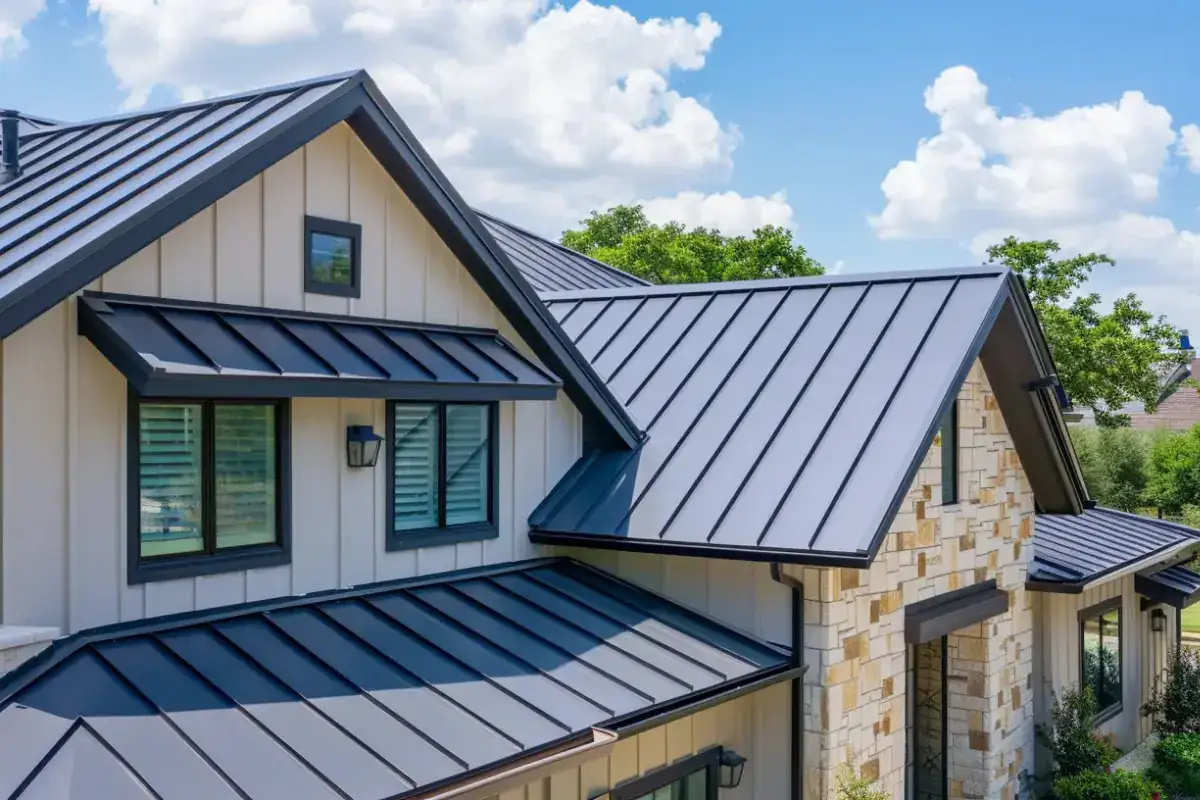
The Complete Roofing Guide for Live Oak
Live Oak has two roofing markets inside one city. The older core is on its third roof over thin plank decking with undersized original ventilation; the newer subdivisions are hitting first replacement with decking that is still sound.
Roofing in Live Oak, and why it isn't like anywhere else
Live Oak sits in northeast Bexar County where I-35 meets Loop 1604, immediately adjacent to Randolph Air Force Base. It is an established suburb rather than a new one, and its housing stock splits cleanly into two eras: original 1960s through 1980s construction in the older core, and 1990s through 2010s subdivisions built out toward the edges. That split is the whole engineering story here. The two groups fail differently, cost differently, and need different scopes.
Layer on Randolph proximity — military ownership, PCS turnover every two to four years, and steady demand for pre-listing roof certifications — plus reliable hail exposure along the I-35 corridor, and you get a market where the right answer depends heavily on which side of town you are on and how long you plan to stay.
The National Weather Service warning for the September 11, 2026 hail storm named Live Oak. See the confirmed storm path and reports.
How Live Oak weather actually loads your roof
Corridor hail, open wind on the newer side, mature canopy on the older side, and blackland clay to the east. Each loads the roof differently.
What we see most often on Live Oak roofs
Why roofs actually fail, from a systems point of view
Atrium Roofing is engineer-led. Here's how we think about your roof as a system, not a stack of shingles.
The first question we ask about a Live Oak roof is not what shingle you want. It is how old the house is, because that single fact determines what is under the shingles. On a 1970s home in the older core, the deck is likely plank or thin sheathing that has already been penetrated by two prior nailing patterns. Fasteners in worn holes do not hold to the manufacturer's wind rating, and no shingle warranty survives a substrate that cannot hold a nail. On a 2004 subdivision home, the deck is almost always sound OSB and the job is a clean tearoff.
The second question is ventilation. Older Live Oak attics were built to a standard that predates any serious understanding of attic thermal performance, and they usually have exhaust without intake. Adding ridge vent to a house with blocked soffits makes the problem worse, not better, because the system pulls conditioned air out of the living space instead of outside air through the soffit. We verify intake first and size exhaust to match it.
Class 4 impact-rated asphalt as the default
Live Oak's hail exposure is genuine and recurring. On both housing eras we default to Class 4 impact-rated asphalt. The material premium is modest relative to the total job, most carriers discount the wind and hail portion of the premium for a UL 2218 Class 4 roof, and the resistance to 1"–2" stones is physical rather than marketing.
Ownership horizon changes the honest answer
With Randolph next door, a large share of our Live Oak customers know their departure date. If you have five years of roof life left and a flashing failure, repair it and keep the documentation. If the roof is at end of life or carries an open hail claim, replacing before you list usually recovers more than a repair credit at the closing table. We will tell you which one you are in, including when the answer is that you should not spend money yet.
Three paths, and how to know which one fits
What roofing actually costs in Live Oak
Live Oak sits mid-range for the metro. Newer subdivisions price like production work; the older core prices higher because of decking, ventilation correction, and access under canopy. Ranges are 2026 Central Texas figures for typical single-family homes. These are ranges based on typical local jobs, and the actual number depends on your roof.
- Which housing era the home belongs to, which drives decking and ventilation scope.
- Sheets of decking replaced after tearoff, priced per sheet in the contract. Decking condition varies far more across Live Oak than in a uniform-age market, so the per-sheet allowance matters more here than almost anywhere else we work.
- Number of existing roof layers to remove.
- Class 3 versus Class 4 shingle selection.
- Gutter linear footage, downspout count, and whether guards are warranted under canopy.
- Whether the work is insurance-funded or out of pocket.
Paying for a roof without draining savings
Because the older-core scope often includes decking and ventilation correction, we quote those line items separately so you can see what you are paying for the substrate versus the shingle. Financing terms run 60 to 180 months. Financing is subject to credit approval. The terms shown here are examples, and your actual rate, term, and payment depend on the lender's decision.
On an insurance-funded job, the deductible is usually the only real out-of-pocket, and financing it is common. Atrium offers 0% APR financing for up to 12 months, subject to credit approval.
Roof systems that hold up in Live Oak
These aren't the cheapest options. They're the ones that actually make it to their warranty on Central Texas roofs.
Atrium's 5 Engineered Systems
Available on any Live Oak roof. Full assemblies, not just shingles. Your install may be eligible for a registered manufacturer system warranty.
Roof characteristics by Live Oak neighborhood
Housing stock, roof age, and the failure modes we see most often, block by block.
Around Live Oak
A little context helps calibrate what a roof in this specific community faces.
Roofing services we deliver in Live Oak, TX
The 1960s–1980s core and the 1990s–2010s edge subdivisions are two different jobs. We scope and price them that way rather than quoting a single square-foot number for the city.
Roof replacement in Live Oak splits along the same line the housing stock does. In Bracken Village and the newer edge tracts, replacement is a clean production scope: full tearoff, sound OSB deck, synthetic underlayment, ice-and-water membrane in valleys and at wall lines, new flashings, balanced ventilation, and a Class 4 impact-rated system registered in the homeowner's name. In Live Oak Hills, Coronado Village, and Forest Bluff, the same job usually includes re-decking over plank sheathing and correcting soffit intake that was never adequate. We quote those items separately so you can see the substrate cost apart from the shingle cost.
Roof repair in Live Oak is dominated by flashing on the eastern, clay-influenced side and by canopy-related wear on the older side. We rebuild chimney flashing with cut reglets and new counter flashing rather than resealing a joint that will open again next season, install real kickout flashing at every wall-to-roof termination, and replace shingles abraded by overhanging live oak limbs.
Storm damage roof repair is seasonal and predictable in this corridor. We inspect at no cost, document functional damage with dated photos and measurements, and tell you honestly whether a claim is worth filing. When it is, we meet the adjuster on the roof and document what we find. Our hail damage guide explains how functional and cosmetic damage differ.
Gutter installation and gutter repair carries unusual weight in Live Oak because half the city sits under mature live oak canopy and the other half sits under open sky with intense rainfall. We install 6-inch seamless aluminum with correctly spaced 3x4 downspouts and discharge extensions that carry water well clear of the slab, and we add guards where leaf load actually justifies them. Our seamless gutter installation and repair guide covers sizing, downspout spacing, and discharge in detail.
Ventilation and attic performance work is the highest-leverage upgrade on older Live Oak homes. Most were built with exhaust and no meaningful intake, which is why their decks run hot and their shingles age early. See our attic ventilation guide for the physics behind balanced intake and exhaust.
Pre-listing roof certification and PCS-timeline planning is routine work for us given Randolph. We inspect, document remaining service life, and issue written certification for buyers, agents, and VA appraisers on a schedule that fits your orders.
How Live Oak's location and canopy actually damage roofs
Corridor hail is the headline load. Underneath it, canopy and soil split the city into two distinct failure patterns.
Hail along I-35. Live Oak sits on the same storm tracks as Selma, Schertz, and Universal City, and 1"–2" stones are a recurring event rather than a rare one. Class 3 shingles survive typical events with cosmetic marking. Class 4 impact-rated systems resist larger stones without fracturing the mat. Soft metals — gutters, vent caps, flashing — dent first and are usually the clearest evidence an adjuster will accept.
Expansive clay on the eastern side. Blackland clay swells with moisture and shrinks in drought. The slab does not move uniformly, the frame racks with it, and the roof concentrates that movement at its most rigid joints: chimney flashing, wall-to-roof step flashing, and long ridge lines. Homeowners describe it as a leak that keeps coming back in the same place, which it does, because the cause is under the house.
Mature canopy in the older core. Live Oak Hills and Coronado Village sit under substantial live oak cover. That means constant fine debris in gutters, abrasion where limbs contact the roof plane, genuine limb-impact risk in straight-line wind, and north slopes that stay damp enough to grow algae and hold moisture against the shingle surface.
Open wind and full-day UV on the newer side. The edge subdivisions have flat lots and immature landscaping, so outflow winds hit ridge caps and rake edges at full speed and south and west slopes take unshaded sun all day. Hand-sealed ridge caps, starter strip at every rake and eave, and a correct six-nail pattern are baseline on any reroof we do there.
Rainfall intensity. Central Texas storms deliver large volumes in short bursts. A gutter system sized for average rainfall overflows in the storms that matter, concentrating water at the foundation — which on the clay side feeds exactly the soil cycle that keeps cracking your flashings.
Live Oak, TX — where we work
We serve homeowners throughout Live Oak and the surrounding northeast Bexar corridor — from Live Oak Hills and Coronado Village in the older core, through Forest Bluff and Woodcrest, out to Bracken Village and the Northern Hills area along Pat Booker Road and Loop 1604.
What homeowners actually say
Published, verifiable reviews from third-party platforms, not marketing copy.
Live Oak homeowner questions
Related resources
Let's take a look at your roof in Live Oak.
No pressure, no obligation. Calls answered 24/7 in English & español by Alex, our AI specialist · Get an engineer-led 53-point roof inspection, not a sales pitch.