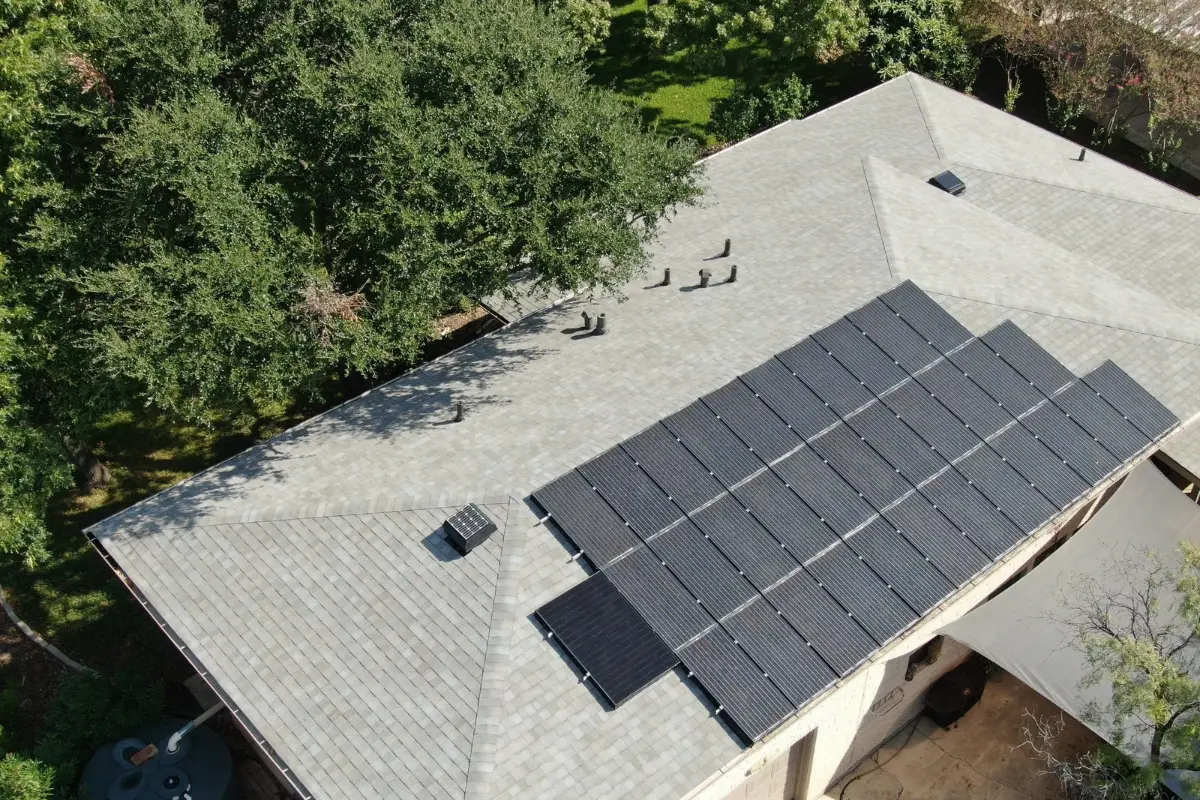
Energy-Efficient Roofing in San Antonio, Engineered to Cut Attic Heat
A complete engineered roofing system chosen for thermal performance, offered as a Class 3 cool-roof shingle path or a Class 4 standing seam metal path.
One system, two coverings, one organizing idea.
THERMALGUARD™ is the system a homeowner picks when the deciding factor is heat and cooling cost rather than impact class alone.
Our other four engineered systems — FOUNDATION™, IMPACTSHIELD™, STORMLOCK™, and LEGACY™ — are organized around a UL 2218 impact class. THERMALGUARD™ is organized around thermal performance, and that changes the shape of the system. It spans two very different roof coverings, because there are two very different ways to build a roof that handles Central Texas heat well.
These two paths are not a hierarchy. A cool-roof asphalt shingle at Class 3 and a standing seam metal roof at Class 4 both qualify as THERMALGUARD™ because both are selected for how the covering behaves thermally. Which one fits comes down to the house, the roof geometry, and the budget — not to which one sits higher on a chart.
Who it's for
Homeowners prioritizing energy efficiency and long-term cooling cost reduction. If your summer electric bills are the thing that made you start looking at your roof, this is the system to read about. The Class 3 asphalt path keeps the upfront cost closer to a standard replacement while still delivering cool-roof granule technology and a documented impact rating. The Class 4 metal path costs more upfront and returns the longest service life and the highest impact class.
What a THERMALGUARD™ roof is made of
This is a representative configuration, not a fixed spec sheet. Component selection varies by project, and the exact list is written on your proposal before anything is ordered.
A UL 2218 Class 3 impact-rated architectural shingle built with 3M Cool Roofing Granules and designed to meet Cool Roof Rating Council Solar Reflectance Index standards. It includes 3M Scotchgard Protector for algae resistance and 3M Smog-Reducing Granules. Wind warranty: Up to 160 mph limited wind warranty when installed as an Atlas Signature Select Roofing System with Atlas Pro-Cut starter shingles at the eaves and rakes, per Atlas.
A Class 4 impact-rated standing seam metal covering, reflective by material rather than by granule technology. Panel gauge, finish system, reflectivity, service life, and cost ranges are covered in full on our San Antonio metal roofing page.
Same-manufacturer hip and ridge on either path, though the specific ridge product differs by covering type. It is part of the component minimum a manufacturer requires before it will register an enhanced system warranty, and it is standard on every Atrium engineered system.
Balanced intake and exhaust sized to the attic, on every install. On an energy-focused system it matters twice over: a reflective covering reduces the heat arriving at the deck, and ventilation moves out the heat that still gets through.
Underlayment, ice and water barrier, starter course, and flashings follow the same five-layer system described in “The system, not the shingle” on our roof replacement page. If you are still deciding between covering types generally, our roofing materials guide and the roof cost calculator are the right next stops.
Price a THERMALGUARD™ roof from your address
We measure your roof from aerial imagery and apply the THERMALGUARD™ per-square rate. No email or phone number needed to see the number.
Pick a system and enter the property address. We return roof area in squares, including waste, and the installed cost range that area implies at our published rates. Nothing is gated behind a contact form.
What the reflective path actually earns back
This isn't an insurance discount — it's a real, currently-running utility rebate, plus a lower cooling bill. Here's what's verified, and what still depends on your specific roof.
3M Cool Roofing Granules reflect more solar energy than standard granules; 3M Scotchgard Protector keeps them that way by resisting the algae staining that would otherwise darken the roof and cut its reflectivity over time.
of conditioned living space (not roof area) — a real, currently-running CPS Energy program, not an Atrium estimate. Exact tier depends on the installed material's documented CRRC reflectance rating.
CPS Energy's own published figure, citing ENERGY STAR, for a properly installed cool roof.
How the rebate can look on a typical home
CPS Energy's own published example: for a roughly 1,800 sq ft home (conditioned space — not the roof's square footage), the Cool Roof rebate works out to somewhere between $144 and $360, depending on the material's documented reflectance tier. Confirm current tiers and eligible products directly with CPS Energy before counting on a specific number — rebate programs change from year to year.
Atlas designs Pinnacle Sun to meet Cool Roof Rating Council Solar Reflectance Index standards, but "designed to meet" isn't the same as a locked-in number for every color — reflectance varies by shingle color, lighter colors reflect more. We'll confirm the specific color and its documented reflectance against CPS Energy's current eligible-product list before you count on a rebate tier. The same CPS Energy program can also apply to a qualifying reflective standing-seam metal finish; ask which of our metal finishes are documented for it.
The manufacturer spec sheet and reflectance rating, plus your project invoice — the two things CPS Energy's application asks for. You submit the rebate application directly to CPS Energy; we make sure you have what it requires.
No voicemail. Alex has a real conversation about the problem and gets it to our team.
What a registered, engineered roof could be worth to you
This estimator covers insurance only. The CPS Energy rebate and cooling savings above are separate.
The cool-roof shingle path is Class 3; the standing seam metal path is Class 4. Your credit depends on which path you choose and on your carrier.
What this roof could be worth to you — in your numbers
Enter numbers from your own policy. This is an illustration, not a forecast.
Enter yours from your policy.
Use the wind/hail line, not the all-peril line. Many Texas policies list it as a percentage.
Ask your agent for this in writing. This page covers a Class 3 or Class 4 roof.
Ask about a cosmetic damage exclusion. Some carriers apply one to roofs that receive an impact-resistant credit. It generally means they will not pay for hail marks that change how the roof looks but not how it performs. Ask your agent, and get the answer in writing before you decide.
Each replacement paid through insurance costs you one deductible. Pick the scenario you want to see.
Enter your dwelling coverage and wind/hail deductible above.
Enter your agent's quote above to see this.
Pick how many replacements to model above.
Premium savings from the discount you entered, plus skipped deductibles from the scenario you picked.
Ask about a cosmetic damage exclusion. Some carriers apply one to roofs that receive an impact-resistant credit. It generally means they will not pay for hail marks that change how the roof looks but not how it performs. Ask your agent, and get the answer in writing before you decide.
What this leaves out
- Roof prices that rise over time.
- How filing claims can affect your premium.
- Anything your policy does not cover.
- Rules that are specific to your carrier.
Class 4 impact-resistant shingles can qualify for a premium discount in Texas. The amount is set by your insurance carrier, so ask your agent what yours would be.
Class 4 earns the highest impact-resistant credit under Texas Department of Insurance guidance. Whether your carrier credits Class 3 at all, and by how much, is its decision. Ask your agent.
Why roof age changes what insurance pays
A $10,000 roof on a house insured for $200,000 with a 2% ($4,000) deductible:
| Roof age | Roof's value | Minus deductible | Policy pays |
|---|---|---|---|
| 5 years | $8,500 | −$4,000 | $4,500 |
| 10 years | $7,000 | −$4,000 | $3,000 |
| 20 years | $4,000 | −$4,000 | $0 |
Source: Texas Department of Insurance example, as published by TDI.
On actual-cash-value policies, payments fall as the roof gets older. Some policies use a roof payment schedule instead, and that varies by carrier. A new roof starts at age zero.
How to claim a credit
- At closeout, you get the impact-resistant certification when it applies to your system. See the Power Package.
- Send it to your agent. Ask them to apply the credit in writing.
- Ask the cosmetic-exclusion question before you sign anything.
The manufacturer's warranty first. Ours underneath it.
A manufacturer-backed system warranty ranks above any contractor's own warranty for one reason: it survives the contractor. If a roofing company closes, changes hands, or simply stops answering the phone, a warranty backed by Owens Corning or GAF is still honored. A contractor's warranty is only worth as much as the contractor still being in business, and that is as true of ours as it is of anyone's.
Atlas Pinnacle Sun installs
Eligible for the Atlas Signature Select Roofing System Limited Warranty, available at PRO+ Gold Select standing, available because Atrium holds Atlas PRO+ Gold Select. It requires a complete Atlas system — shingle, underlayment, and accessories — to be installed, not the shingle alone. Our brands and certifications page explains how contractor certification tiers govern which warranties can be registered at all.
Standing seam metal installs
Metal system warranty terms depend on the specific panel and finish manufacturer used on your project. That is not a single certified relationship the way it is with our shingle manufacturers, so we do not state a blanket metal warranty here. See our San Antonio metal roofing page for the material detail, and talk to us for the warranty specifics on the panel and finish specified for your roof.
Atrium's workmanship layer
Atrium backs every roof replacement with a written 10-year workmanship warranty. It is non-prorated, so coverage in year ten is identical to year one, and it is fully transferable to the next owner. If a covered installation defect appears, we cover the labor and the materials to correct it.
The warranty covers the roof replacement we performed. It is our installation of your new roof system that carries the ten years.
It covers our installation, and that is all it covers. It is not insurance and it does nothing for hail, wind, or anything else an insurance claim would handle. The manufacturer's warranty on the shingles themselves is a separate document.
If you want the mechanics behind all of this — how the two documents differ, what quietly voids them, and how the certification tier decides which one can be registered — our roof warranty guide walks through it.
Whichever warranty applies to your system is registered in your name and delivered as part of the Power Package — up to five documents, depending on your roofing system; on a shingle system that includes the supplier's material invoice.
Why a reflective covering matters in San Antonio
San Antonio sits in one of the highest cooling-degree-day regions in the country. For most of the year the roof is the surface absorbing the most solar energy on the house, and whatever heat it takes on ends up in the attic, then in the ceiling, then in the cooling load your system has to fight.
A reflective roof covering changes that first step. Atlas Pinnacle Sun does it with 3M Cool Roofing Granules engineered to meet Cool Roof Rating Council Solar Reflectance Index standards. Standing seam metal does it inherently through the panel and finish system — the reflectivity figures for that path are documented on our metal roofing page rather than repeated here.
Neither path is a substitute for ventilation or insulation, which is why enhanced attic ventilation is standard on the system rather than an upsell. A reflective covering reduces the heat arriving at the deck; balanced ventilation moves out what still gets through. Those two working together is what actually shows up on a summer bill.
THERMALGUARD™ FAQs
Let's spec the right system for your roof.
No pressure, no obligation. Calls answered 24/7 in English & español by Alex, our AI specialist · Get an engineer-led 53-point roof inspection, not a sales pitch.