
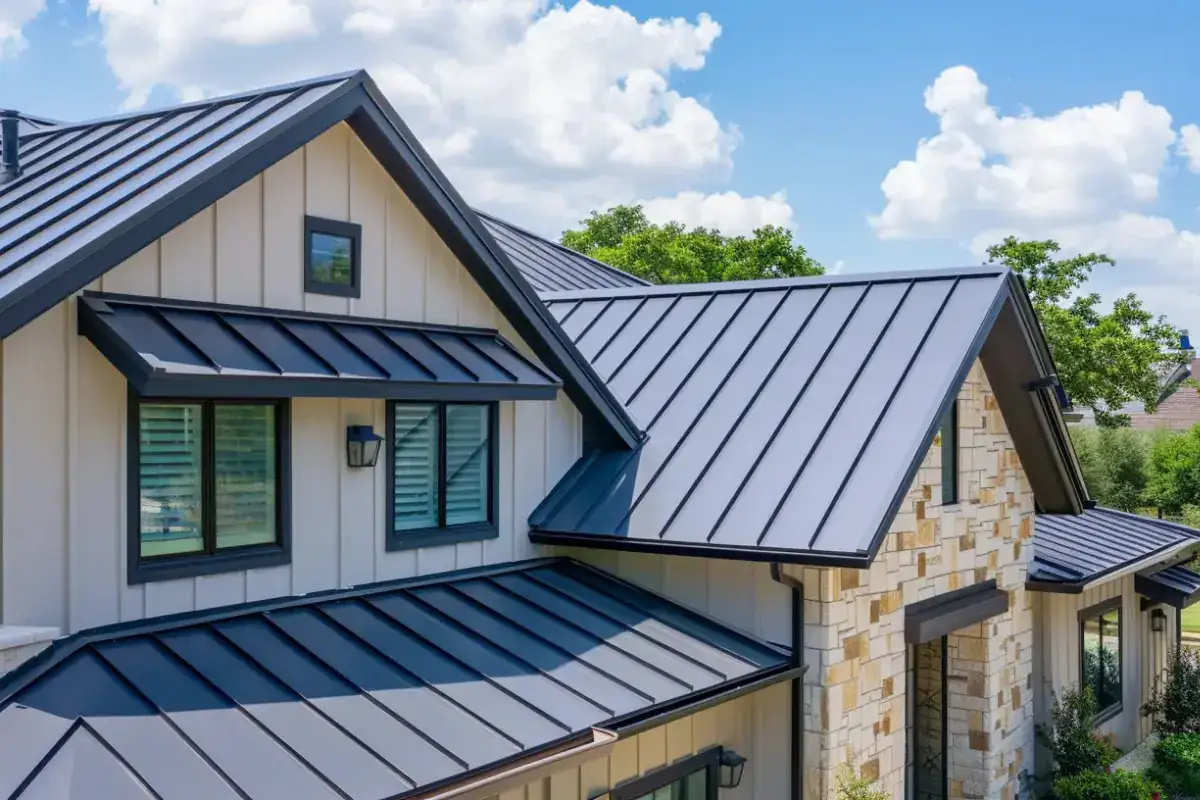
Cross-section illustration of a lifetime engineered roofing system installed in New Braunfels, showing decking, underlayment, and shingle layers.
North San Antonio · Roofing knowledge center

The Complete Roofing Guide for Stone Oak

Stone Oak homes have some of the biggest, most complex roofs in Bexar County — and the pricing to match. This guide is written for homeowners planning a real, no-surprises replacement.
Local introduction

Roofing in Stone Oak, and why it isn't like anywhere else

Stone Oak's housing stock is unusually consistent for a Central Texas market: large 2- and 3-story custom and semi-custom homes built primarily between the mid-1990s and mid-2010s, with cut-up rooflines, multiple valleys, dormers, and often concrete tile or higher-spec shingle systems. It's not a starter-home market and it doesn't reroof like one.

The dominant story right now is age. The first big wave of Stone Oak construction is 20–25 years past install. That roof is at end-of-life whether it looks like it or not. Homeowners in The Bluffs at Stone Oak, Rogers Ranch, and the older Sonterra pockets are in the replacement window this decade, and the projects are meaningfully more complex than an equivalent suburban reroof further south.

This guide is meant to help you plan that project — realistically, without the marketing polish, and with an understanding of what a Stone Oak-appropriate scope actually includes.

Climate & weather

How Stone Oak weather actually loads your roof

Stone Oak sits on the northern Bexar County escarpment. Elevation, exposure, and building era combine to create a specific set of roofing pressures.

Higher elevation UV load
The elevated Stone Oak plateau sees slightly higher direct UV than downtown Bexar County. Shingle fade and granule oxidation are measurable.
Wind on 3-story elevations
Third-floor rooflines catch more wind than typical suburban ranches. Ridge caps, drip edge, and rake trim on upper elevations blow off first.
Hail alley terminus
Storm cells crossing north Bexar County frequently drop hail across Stone Oak. 1.5"+ events every 2–3 years.
Cut-up rooflines complicate drainage
The dominant architectural style — multiple gables, hip transitions, and dormers — creates many valleys, and every valley is a potential leak point if undersized.
Reduced tree canopy
Compared to Garden Ridge or Alamo Heights, Stone Oak has less mature canopy — meaning less debris but more direct sun exposure on shingles.
Concrete tile thermal cycling
Tile roofs common here cycle 100°F+ between summer surface temp and winter overnight lows. Underlayment beneath tile ages faster than most homeowners realize.
Common problems

What we see most often on Stone Oak roofs

End-of-life 25-year architectural shingles
The dominant issue right now in Stone Oak. Roofs installed 1998–2005 with builder-spec architectural shingles are past service life. Widespread granule loss, brittle shingles, and multiple small leaks characterize this cohort.
Underlayment failure under concrete tile
Boral, Eagle, and clay tile roofs common in Rogers Ranch and Sonterra have 50-year tile over 25-year underlayment. When homeowners see 'tile lasts forever' they miss the underlayment that actually keeps water out.
Valley failure on cut-up rooflines
Undersized open-valley metal on complex custom rooflines silts and backs water. Multiple-valley leaks on a Stone Oak custom are common and require re-detailing during any reroof.
Third-story ridge cap blow-off
Upper-elevation ridge caps see more wind. Hand-nailed ridge caps installed to code minimums lift in 60+ mph gusts. Almost every post-storm Stone Oak call involves ridge cap work.
Chimney flashing failure on stone and stucco chimneys
Full-height stone and stucco chimneys move with foundation cycling. Original step and counter-flashing rusts and pulls loose. Reflashing during any reroof is essentially mandatory.
Ventilation inadequate for roof volume
Big roofs with steep pitches and multiple planes were often ventilated with box vents at code minimum. Actual airflow is far below what the assembly needs; attic temperatures cook shingles from below.
Diagnosing something specific? Our roof problem guide walks through leaks, granule loss, sagging, and ventilation failures step by step.
Engineer's perspective

Why roofs actually fail — from a systems point of view

Atrium Roofing is engineer-led. Here's how we think about your roof as a system, not a stack of shingles.

A Stone Oak reroof is not a suburban shingle swap. It's a systems reset on a big, complex assembly that was often installed to production standards fifteen or twenty years ago. When we scope one, we look at the whole assembly — decking, underlayment, valleys, penetrations, flashings, ridge and rake detail, and ventilation — because touching only the shingle rarely solves the actual problem.

Underlayment is the actual roof

Shingles shed most water. Underlayment catches what gets past them. On Stone Oak's complex rooflines with dozens of penetrations, the underlayment does more work than average and needs to be treated as a first-class component — synthetic across the field, ice-and-water in every valley and around every penetration, minimum.

Ventilation redesign is part of the reroof

Nearly every 1998–2005 Stone Oak home we reroof needs its ventilation redesigned. Adding continuous soffit intake, replacing box vents with a properly sized ridge vent, and matching exhaust to intake volumes drops attic temperatures 20–30°F and extends the next shingle's service life measurably.

Tile underlayment replacement is a real project

A tile reroof — meaning tile removal, underlayment replacement, and tile reinstall — is a legitimate 2–3 week project on a Stone Oak custom. The tile itself is usually reusable. The underlayment beneath it is the actual failure mode after 20+ years.

Repair, replace, or claim

Three paths, and how to know which one fits

Roof Repair
When damage is isolated — a failed pipe boot, a wind-lifted ridge cap, a valley leak on an otherwise healthy Stone Oak roof — a targeted repair is almost always the right call. Expect $400–$2,500 for most residential repairs, with a written scope so you know what's being touched and what's being left alone.
See Stone Oak Roof Repair Options
Roof Replacement
Once a roof is past 18–20 years, has multiple leak points, or shows widespread granule loss and decking softness, a full system replacement wins on cost per year of service. See our full replacement guide.
View the Full Stone Oak Roof Replacement Guide
Storm Damage
Hail, straight-line winds, and tree impact from Central Texas storms may qualify for an insurance-funded replacement. We inspect first, document with photos, and only recommend a claim when damage is genuinely functional — never cosmetic.
Report Stone Oak Roof Storm Damage
Ballpark costs

What roofing actually costs in Stone Oak

Stone Oak pricing reflects large, complex roofs, higher installation labor for steep pitches and third-story access, and often premium materials. Ranges below are for 3,000–4,500 sq ft custom homes. These are ranges based on typical local jobs, and the actual number depends on your roof.

Small repair
$600 – $1,600
Pipe boot, single ridge or valley section, small flashing repair.
Mid repair
$1,600 – $5,000
Multi-valley re-detail, chimney reflash, tile section reset and reunderlay.
Architectural reroof (3,500 sq ft roof footprint)
$20,100 – $25,400
Malarkey Vista or GAF Timberline HDZ, full tearoff, upsized valleys, ventilation redesign, all new flashings.
Class 4 impact reroof
$23,300 – $29,600
Malarkey Legacy — the strongly recommended upgrade in this hail corridor.
Concrete tile reroof (relay existing)
Quoted after inspection
Tile removal, new synthetic underlayment, new flashings, tile relay. Broken tiles replaced piece by piece.
New concrete tile install
Quoted after inspection
Full new Boral or Eagle system with all supporting components.
How much would a new roof cost in Stone Oak?
Get an instant estimate
What moves the number
  • Number of stories — 3-story homes require staging and add labor.
  • Pitch — 10/12 and steeper is standard on Stone Oak customs; adds significant labor.
  • Valley count and roof complexity — 10–15 valleys common.
  • Access — HOA requirements and gated communities affect staging.
  • Ventilation redesign scope.
  • Tile handling and breakage rate on reroofs.
For a full breakdown by material, layer, and roof complexity, see the Central Texas roof cost guide. Compare shingles vs. metal vs. tile side by side in our materials comparison.
Financing

Paying for a roof without draining savings

Stone Oak replacements are large enough that financing is a real conversation. A $45,000 reroof over 120 months at 6.9% APR runs roughly $520/month — a payment that's usually a small line item against Stone Oak household budgets, and lets the homeowner keep liquid savings intact.

Insurance-funded jobs use the standard 0% APR bridge for the deductible portion. Wind/hail deductibles here are commonly 1–2% of dwelling — often $6,000–$15,000. Financing that deductible is normal. Full-cash retail replacements make sense on homes the owner plans to sell within a few years, where the marginal appeal to buyers pays back the up-front commitment.

Full terms and monthly payment calculators live on our financing page. If a storm was involved, our insurance guide explains how deductibles and depreciation actually work.
Recommended systems

Roof systems that hold up in Stone Oak

These aren't the cheapest options — they're the ones that actually make it to their warranty on Central Texas roofs.

Malarkey Legacy (Class 4)
The best asphalt choice for a Stone Oak reroof. Polymer-modified for hail, flexible for thermal cycling on big planes, and the insurance discount is real.
GAF Timberline HDZ with Silver Pledge system warranty
Best-in-class architectural shingle when Class 4 isn't specified. The Silver Pledge requires certified installation and covers workmanship — meaningful on a $40,000 project.
Boral or Eagle concrete tile (new or relay)
The right long-term system for Mediterranean and Spanish-revival Stone Oak customs. 50-year tile life; plan for underlayment replacement roughly every 25 years.
Standing seam Galvalume
Not the visual default in Stone Oak, but appropriate on some contemporary customs. 40+ year life, superior wind performance on upper elevations.
Full valley ice-and-water shield + upsized open valleys
System-level upgrade every Stone Oak reroof should specify regardless of shingle choice. Prevents the recurring valley-leak problem in this housing stock.
Neighborhoods

Roof characteristics by Stone Oak neighborhood

Housing stock, roof age, and the failure modes we see most often, block by block.

1990s–2000s
The Bluffs at Stone Oak
The original Stone Oak custom pocket. Large 2- and 3-story homes with cut-up rooflines. Most original 25-year shingles are now past service life; replacements are peaking now.
1990s–2010s
Rogers Ranch
Higher-end customs, many with concrete tile or premium architectural shingle. Tile underlayment replacements are the dominant project type currently.
1990s–2010s
Sonterra
Golf-course community with a mix of tile, shingle, and standing seam. HOA architectural review is strict; verify materials before ordering.
1990s–2000s
Canyon Springs
Established custom neighborhood with cut-up rooflines and dormers. Ventilation redesign is common during reroofs here.
1980s–1990s
Encino Park & Encino Rio
Older Stone Oak-adjacent, smaller footprints than the newer customs but still complex geometry. Second- and third-generation reroofs now.
2000s–2010s
The Vineyard
Newer customs with better original ventilation specs. Watch for improperly nailed ridge caps and rake trim.
2010s–2020s
Trails at Herff Ranch, Cibolo Canyons
Recent construction. Original roofs still within service life. Preventive maintenance is the current conversation, not replacement.
Local context

Around Stone Oak

A little context helps calibrate what a roof in this specific community faces.

Stone Oak's identity has always been shaped by its position — up on the northern Bexar County plateau along the Highway 281 corridor, north of Loop 1604 and stretching toward Bulverde. The TPC San Antonio complex and JW Marriott anchor the eastern edge; Sonterra Country Club and its surrounding fairways define the older core; the Ronald Reagan and Bush Middle School zones are where much of the residential development followed. Retail along 281 at Bitters and at Marshall shows the growth curve directly. Stone Oak feels newer than most of San Antonio because it is — almost everything you see was built after 1990, on land that was ranch and brush before then. That relative youth is exactly why the housing stock all hits replacement age at roughly the same time, and why the Stone Oak roofing calendar is unusually predictable.
Verified reviews

What homeowners actually say

Published, verifiable reviews from third-party platforms — not marketing copy.

4.9★ · 290+ Google Reviews · 60+ Yelp Reviews · 29 Verified GuildQuality Reviews · A+ Rated by BBB · 100% Would Recommend
"Atrium Roofing was very professional. I did my own research, and that's why I chose them. I talked to the owner, Jose, and he was very professional. I liked how they did business. They are a good, respectable business."
Ray J.
San Antonio, TX
Verified · GuildQuality
"Efficient estimate, provided support and guidance in understanding the roofing and insurance process."
Susan L.
San Antonio, TX
Verified · GuildQuality
"Great experience, from start to finish. Owner did 3 onsite visits. The General Manager made an onsite visit. The owner worked with my insurance adjuster directly. Always available to answer questions. He was very knowledgeable and patient with ALL of my many questions. The roofers even showed up a little early. Kept the area clean and, poof, they were done. Excellent. Would highly recommend."
Cheryl D.
San Antonio, TX
Verified · GuildQuality
Frequently asked

Stone Oak homeowner questions

Widespread granule loss (visible bald spots), multiple leak locations, brittle shingles that snap when lifted, and roof age over 18 years together mean end-of-life. Any two out of four is enough to plan replacement.

The tile itself almost never fails structurally — it's usually the underlayment beneath. A tile reroof means removing tile, replacing underlayment, and relaying the tile. Broken tiles are replaced piece by piece.

On most Boral and Eagle systems, 85–92% of tiles are reusable after 20 years. Boneyard tile is used for replacements; new tile is ordered only if needed.

In this hail corridor, yes. The insurance discount pays back the upgrade in 5–7 years, and the hail resistance is functional not marketing.

Upper elevations catch more wind than the aggregate wind map suggests. Ridge caps installed to code minimums (4 nails, standard sealant) lift in 60+ mph gusts. We use 6 nails and full-length hand-sealing on upper elevations.

3–5 days on a typical 3,500 sq ft complex custom. Tile reroofs run 10–15 days. We schedule around weather and never install during rain.

Yes — every Stone Oak HOA has architectural review. Sonterra, Rogers Ranch, and The Bluffs all specify approved materials and colors. Submit before ordering.

Only if the trusses are engineered for the additional dead load. Requires structural engineer review. Sometimes possible with truss reinforcement; often the math doesn't work.

Prior repairs don't prevent a full replacement. During tearoff we usually find evidence of 2–3 prior repair attempts on Stone Oak roofs at end-of-life.

Panels come off, roof goes on, panels reinstall. Budget $2,500–$5,000 for panel handling. We coordinate directly with the solar installer.

Continuous soffit intake if it's not already there, ridge vent replacing box vents, and often additional exhaust on separate roof zones. Most 1998–2005 Stone Oak homes need this.

6–12 sheets on a 3,500 sq ft Stone Oak custom, usually concentrated around penetrations and valleys where prior leaks softened the OSB.

A manufacturer system warranty in writing with your name on it. GAF Silver Pledge, Owens Corning Platinum Preferred, or Malarkey certified installer warranty. Not the 'lifetime shingle' printed on a bundle. Underneath that sits Atrium's own written 10-year workmanship warranty on the roof replacement itself, non-prorated and fully transferable.

Yes, once. Transfer is a real selling point in Stone Oak's market — buyers here look for it.

Yes. Common terms are 84–120 months at low APR. Insurance-funded jobs use 0% APR bridges for the deductible.

Chapter 542A gives you one year from date of loss to file. On complex Stone Oak roofs, some hail damage isn't visible from the ground — schedule proactive post-storm inspections.

Local permanent address, RCAT certification, GAF Certified Plus or higher or Owens Corning Platinum Preferred certification, insurance certificates, and photos of local completed customs. Verify each independently.

No. Expect noise 7am–5pm for the project duration. Move wall-mounted art on exterior walls and don't park under the eaves.

Very much so. After any hail event, out-of-state crews canvass Stone Oak neighborhoods promising 'free roofs.' Never sign anything with a door-knocker. Get local quotes.

$800–$2,500 depending on chimney height, material (brick vs. stone vs. stucco), and access. Almost always necessary during a reroof on 20+ year old homes.

Beautiful and long-lasting — 50+ years. Cost premium is $8–$14 per linear foot over painted aluminum. Common on higher-end Stone Oak customs.

Technically yes, cosmetically no — new shingles won't match aged ones. Insurance carriers may pay only for the damaged slope; talk with your adjuster about matching provisions.
Have a specific Stone Oak roof question?

Send a photo or address — we'll respond with an honest assessment, whether that's monitor, repair, or replace.