
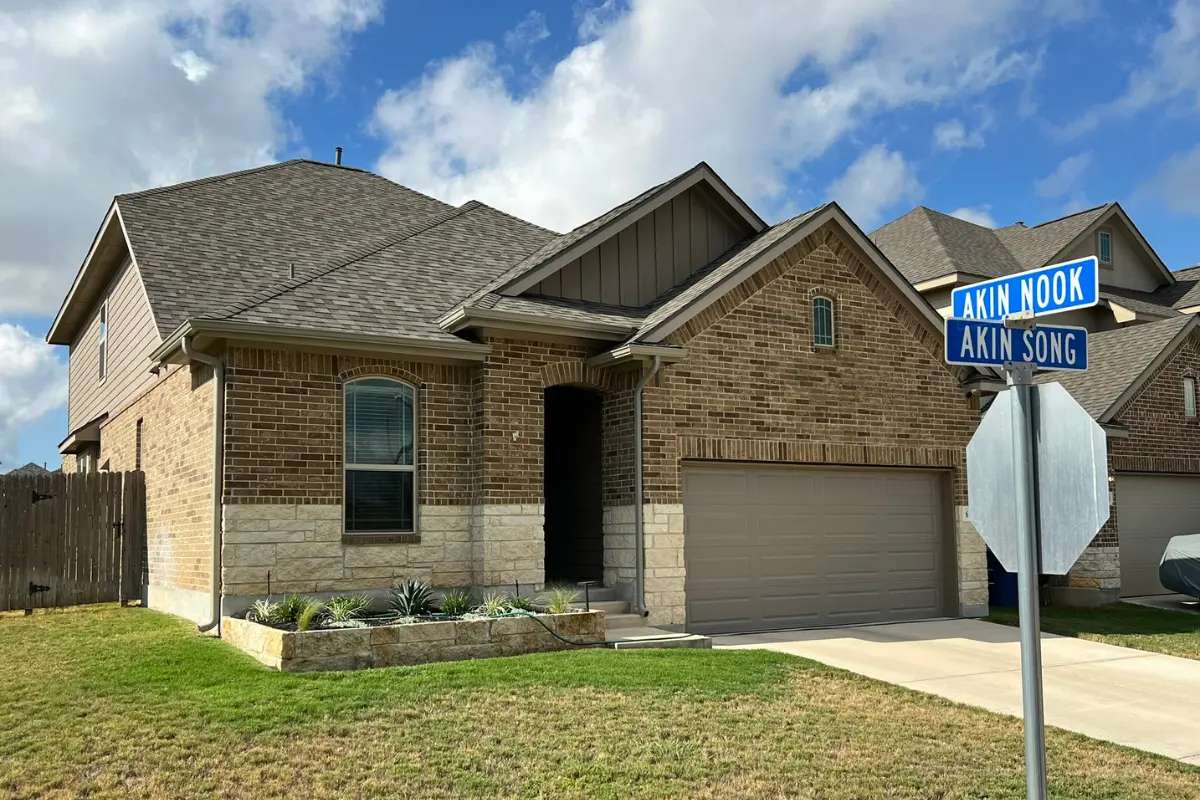
Cross-section illustration of a lifetime engineered roofing system installed in New Braunfels, showing decking, underlayment, and shingle layers.
North San Antonio · 78213/78216 · Roofing knowledge center

The Complete Roofing Guide for Castle Hills

Small footprint, big trees, and mid-century housing stock that's aging predictably. Castle Hills reroofs are a specific project category — different from surrounding North San Antonio.
Local introduction

Roofing in Castle Hills, and why it isn't like anywhere else

Castle Hills is an unusual municipality — an independent city entirely surrounded by San Antonio. That governance detail matters more for roofing than it seems, because Castle Hills has its own permitting, its own code enforcement, and its own community expectations that don't always match the surrounding city.

The housing stock is remarkably consistent: 1950s–1970s ranch and mid-century homes on tree-lined streets, with occasional 1980s–90s infill customs. Most original roofs have been replaced once already, and many are in their second replacement window now. Complex hip-and-valley geometry on the 1960s ranch style creates more transitions than modern production layouts.

Climate & weather

How Castle Hills weather actually loads your roof

Same broader Bexar climate as San Antonio, but Castle Hills' mature canopy and older housing create specific pressures.

Heavy mature canopy
Live oaks and pecans throughout Castle Hills create heavy debris in valleys and gutters.
Older attic assemblies
1960s attics were built with gable vents and turbines, no soffit intake. Ventilation upgrades are essentially universal during reroofs.
Hail corridor overlap
Same north Bexar hail exposure. 1.5"+ events every 2–3 years.
Chimney flashing failure common
60+ years of foundation cycling cracks step and counter-flashing on brick chimneys.
Original decking materials
Some pre-1970 homes have plank decking or early plywood that needs replacement during tearoff.
Cooler humid shaded slopes
Canopy over north slopes holds moisture. Algae streaking appears early.
Common problems

What we see most often on Castle Hills roofs

End-of-life second-generation shingles
Homes reroofed in the late 1990s or early 2000s are at end-of-life now. Third replacement is the current wave.
Chimney reflashing throughout
Almost universal need on 60+ year old brick chimneys. Rusted step flashing behind stucco or siding is the leak source.
Valley debris and silting
Live oak and pecan debris packs open valleys. Twice-yearly cleaning is essential.
Complex ranch-style leak points
1960s hip-and-valley ranches have many transitions. Each is a potential leak point if flashed improperly.
Attic condensation misread as leak
Undersized ventilation causes winter condensation on cool decking. Ceiling stains that appear in January, not July, are usually condensation.
Wildlife entry at soffit gaps
Squirrels and raccoons exploit aged soffit and rake trim. Once inside, they damage insulation and eventually decking.
Diagnosing something specific? Our roof problem guide walks through leaks, granule loss, sagging, and ventilation failures step by step.
Engineer's perspective

Why roofs actually fail — from a systems point of view

Atrium Roofing is engineer-led. Here's how we think about your roof as a system, not a stack of shingles.

Castle Hills reroofs are almost always about correcting decades of accumulated compromise. We rarely walk a roof here that hasn't had at least two prior repair attempts by different hands.

Ventilation redesign is standard scope

Every pre-1990 Castle Hills reroof includes continuous soffit intake added, ridge vent replacing turbines or box vents, and matched exhaust volumes. The airflow improvement is immediately measurable on a July afternoon.

Full tearoff, never overlay

Overlaying disguises decking damage that Castle Hills' housing stock frequently hides. Full tearoff is baseline in our estimates, regardless of what the prior contractor offered.

Preserve character, upgrade performance

Castle Hills residents typically want to preserve the neighborhood's mid-century character. Heritage-color premium shingles, low-profile ventilation, and matched drip edge finishes deliver modern performance without altering the streetscape aesthetic."

Repair, replace, or claim

Three paths, and how to know which one fits

Roof Repair
When damage is isolated — a failed pipe boot, a wind-lifted ridge cap, a valley leak on an otherwise healthy Castle Hills roof — a targeted repair is almost always the right call. Expect $400–$2,500 for most residential repairs, with a written scope so you know what's being touched and what's being left alone.
See Castle Hills Roof Repair Options
Roof Replacement
Once a roof is past 18–20 years, has multiple leak points, or shows widespread granule loss and decking softness, a full system replacement wins on cost per year of service. See our full replacement guide.
View the Full Castle Hills Roof Replacement Guide
Storm Damage
Hail, straight-line winds, and tree impact from Central Texas storms may qualify for an insurance-funded replacement. We inspect first, document with photos, and only recommend a claim when damage is genuinely functional — never cosmetic.
Report Castle Hills Roof Storm Damage
Ballpark costs

What roofing actually costs in Castle Hills

Castle Hills pricing reflects mid-sized homes with complex 1960s hip-and-valley geometry. Ranges assume 1,800–2,800 sq ft single-story. These are ranges based on typical local jobs, and the actual number depends on your roof.

Small repair
$475 – $1,300
Pipe boot, ridge cap, small flashing.
Mid repair
$1,300 – $3,500
Chimney reflash, valley re-detail, wildlife entry seal-up.
Architectural reroof (2,200 sq ft roof footprint)
$12,600 – $16,000
GAF Timberline HDZ or Owens Corning Duration, full tearoff, ventilation retrofit, all new flashings.
Class 4 impact reroof
$14,600 – $18,600
Malarkey Legacy. Insurance discount payback.
Premium architectural (heritage colors)
$21,300 – $26,600
GAF Grand Sequoia or Owens Corning Berkshire designer shingles.
Standing seam metal
$21,300 – $34,600
Less common in Castle Hills but appropriate on modern-styled remodels.
How much would a new roof cost in Castle Hills?
Get an instant estimate
What moves the number
  • Roof geometry — cut-up hip-and-valley adds labor.
  • Chimney reflashing scope.
  • Ventilation redesign.
  • Decking replacement typical on 1960s homes.
  • Tree access affecting staging.
  • Historic color and profile matching.
For a full breakdown by material, layer, and roof complexity, see the Central Texas roof cost guide. Compare shingles vs. metal vs. tile side by side in our materials comparison.
Financing

Paying for a roof without draining savings

Castle Hills reroofs are commonly financed over 60–120 months at low APR. Insurance-funded jobs use standard 0% APR bridges for deductibles. Most homes fall in the $14,000–$25,000 range, well within manageable payment schedules.

Wind/hail deductibles here run 1–2% of dwelling — typically $3,000–$7,000. Financing the deductible against the insurance payment is normal.

Full terms and monthly payment calculators live on our financing page. If a storm was involved, our insurance guide explains how deductibles and depreciation actually work.
Recommended systems

Roof systems that hold up in Castle Hills

These aren't the cheapest options — they're the ones that actually make it to their warranty on Central Texas roofs.

GAF Timberline HDZ with StainGuard Plus
StainGuard suppresses algae on shaded Castle Hills lots. LayerLock nailing zone delivers real wind performance.
Malarkey Legacy (Class 4)
Best insurance-aware choice. Hail resistance plus premium discount.
GAF Grand Sequoia or Owens Corning Berkshire
Designer profiles preserve 1960s architectural character with modern performance.
Enhanced ventilation retrofit
The single highest-value upgrade on any pre-1990 Castle Hills home. Soffit intake plus ridge vent.
Copper or matched-finish drip edge
Small detail that preserves neighborhood character on visible eaves.
Neighborhoods

Roof characteristics by Castle Hills neighborhood

Housing stock, roof age, and the failure modes we see most often, block by block.

1960s–1970s
Castle Ridge & Castle Estates
The original Castle Hills subdivisions. Ranch and mid-century homes with complex geometry. Second-generation reroofs peaking now.
1950s–1960s
Original Castle Hills (Winston area)
Oldest housing stock. Some plank decking still in place. Ventilation redesign essentially mandatory.
1960s–1980s
Country Club area
Larger customs adjacent to the Fort Sam Houston Golf Club. Higher-end original materials. Third-generation replacements common.
1990s–2010s
Newer infill
Scattered 2-story customs replacing tear-downs. Original 25-year shingles at end-of-life.
Local context

Around Castle Hills

A little context helps calibrate what a roof in this specific community faces.

Castle Hills sits inside Loop 410, bounded by NW Military and West Avenue, entirely surrounded by San Antonio proper. The Castle Hills City Hall on Castle Court and the police station give the small city its independent identity. Alamo Heights lies immediately east; North Central Baptist Hospital sits just north. Retail along West Avenue and Loop 410 feels part of the surrounding city but city services — permits, code enforcement, garbage — are separately run. Understanding that governance boundary matters when planning a reroof, because Castle Hills' permit and inspection process is faster and simpler than San Antonio's.
Verified reviews

What homeowners actually say

Published, verifiable reviews from third-party platforms — not marketing copy.

4.9★ · 290+ Google Reviews · 60+ Yelp Reviews · 29 Verified GuildQuality Reviews · A+ Rated by BBB · 100% Would Recommend
"Atrium Roofing was very professional. I did my own research, and that's why I chose them. I talked to the owner, Jose, and he was very professional. I liked how they did business. They are a good, respectable business."
Ray J.
San Antonio, TX
Verified · GuildQuality
"Efficient estimate, provided support and guidance in understanding the roofing and insurance process."
Susan L.
San Antonio, TX
Verified · GuildQuality
"Great experience, from start to finish. Owner did 3 onsite visits. The General Manager made an onsite visit. The owner worked with my insurance adjuster directly. Always available to answer questions. He was very knowledgeable and patient with ALL of my many questions. The roofers even showed up a little early. Kept the area clean and, poof, they were done. Excellent. Would highly recommend."
Cheryl D.
San Antonio, TX
Verified · GuildQuality
Frequently asked

Castle Hills homeowner questions

Faster and simpler. Castle Hills has its own building department with quicker turnaround. Your contractor handles the paperwork.

15–18 years on architectural asphalt with proper ventilation. Class 4 impact can push toward 22.

Insurance discount plus real hail resistance make it a strong choice in this corridor.

Continuous soffit intake added, ridge vent replacing turbines or box vents. Essentially universal on pre-1990 homes.

6–15 sheets on a 1960s home, sometimes more if plank decking is present.

On any 30+ year old chimney, almost certainly yes. Reflashing is standard during any reroof.

Twice yearly on tree-covered lots. Live oak and pecan debris silts valleys quickly.

For heavy-canopy lots, micro-mesh over 6-inch seamless gutters is worth the investment. Foam and brush inserts cause more problems than they solve.

Yes. Most Castle Hills homes finish in 1–2 days.

Trap and remove first, then seal every entry point with hardware cloth and metal flashing. Foam alone doesn't work.

Manufacturer system warranty in writing with your name — GAF Silver Pledge, OC Platinum Preferred, or Malarkey certified. Not the bundle-printed lifetime shingle. Underneath that sits Atrium's own written 10-year workmanship warranty on the roof replacement itself, non-prorated and fully transferable.

Yes, once. Real selling point in Castle Hills' market.

Weathered wood, driftwood, mission brown, and slate are common heritage matches. Verify with any HOA-equivalent expectations.

Same insurance market, but permit and code differences may affect claims. Verify with your carrier.

Uncommon in Castle Hills' aesthetic. Standing seam is appropriate on modern-styled remodels but visually out of place on 1960s ranches.

One year from date of loss. Schedule post-storm inspections proactively.

Same as everywhere in San Antonio metro. Never sign with a door-knocker.

Yes. 60–120 month terms at low APR are standard.

Any addition under 2/12 pitch needs membrane, not shingles. TPO or modified bitumen.

Local permanent address, RCAT and manufacturer certifications, references from other Castle Hills homeowners you can verify.

Castle Hills doesn't have a citywide HOA, but individual neighborhoods may. Verify before ordering.

$700–$2,200 depending on chimney height and material. Almost always included in a reroof scope.
Have a specific Castle Hills roof question?

Send a photo or address — we'll respond with an honest assessment, whether that's monitor, repair, or replace.