
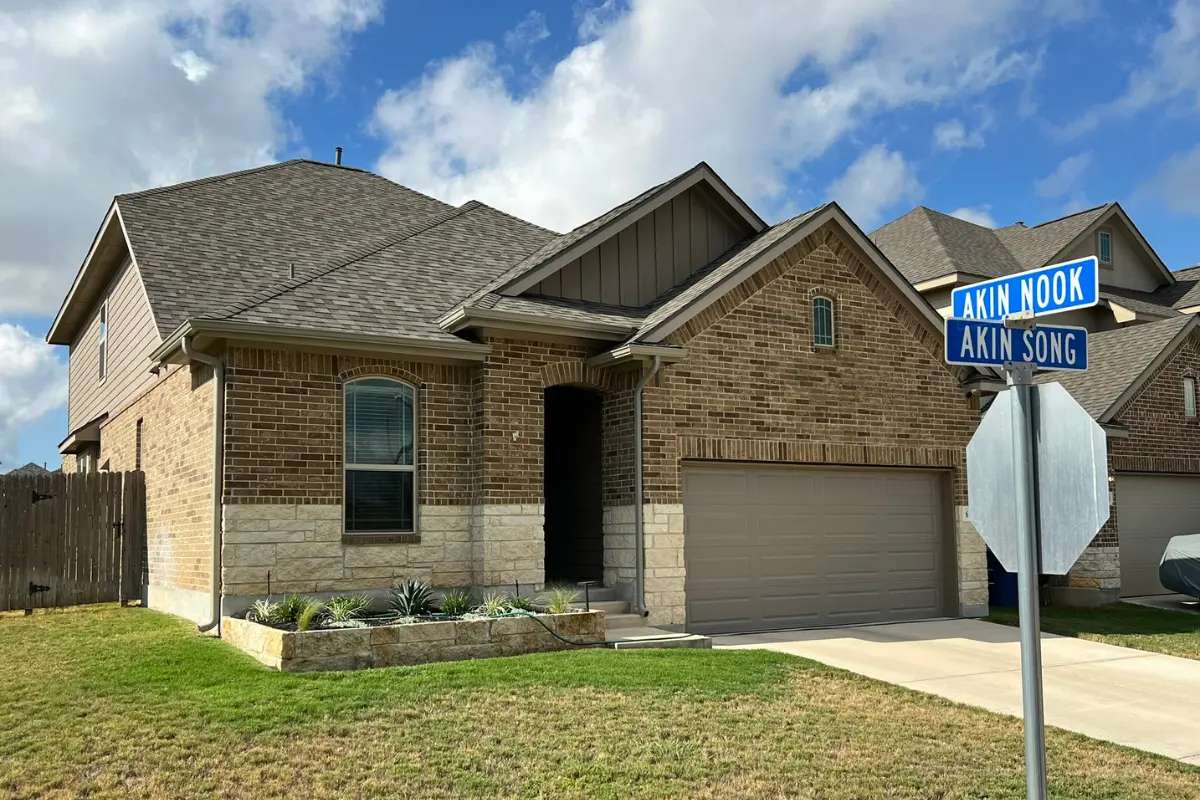
Atrium Roofing crew installing an engineer-led roofing system on a San Antonio residence.
Comal County · Roofing knowledge center

The Complete Roofing Guide for New Braunfels

River-valley humidity, mature oak canopy, and a housing stock that jumps from 1890s German cottages to 2024 production homes — a New Braunfels roof faces a mix nothing else in the region does.
Local introduction

Roofing in New Braunfels, and why it isn't like anywhere else

New Braunfels is a river town, and roofs here get treated like river-town roofs whether homeowners realize it or not. The Comal and Guadalupe pull humidity up into shaded lots year-round, oak canopies dump organic debris into valleys and gutters through fall and winter, and the German heritage neighborhoods around downtown still have small-footprint cottages with steep gables that need a different install approach than a 3,200 sq ft production home in Veramendi.

Population has more than doubled since 2010. That growth has produced miles of new subdivisions along I-35 and out toward FM 306 — and with them, the same builder-grade 25-year architectural shingles that are already failing early in Bexar County. New Braunfels homeowners are two to five years behind San Antonio on the same roofing timeline.

This guide is meant to give you a real picture of what your roof faces here — regardless of whether you live in a 1912 cottage two blocks from Gruene Hall or a 2022 build in Mayfair.

Climate & weather

How New Braunfels weather actually loads your roof

Comal County sits in a humidity pocket the rest of the I-35 corridor doesn't fully share. That changes what actually kills roofs here.

River-valley humidity
Proximity to the Comal and Guadalupe rivers keeps overnight humidity higher than San Antonio year-round. That accelerates algae growth on north-facing slopes and rots any exposed decking fast.
Mature oak canopy
Old-growth live oaks over Landa Park, Gruene, and River Road drop tannins, catkins, and leaves into valleys. Undersized valley metal silts up and backs water under shingle courses.
Hail alley overlap
Comal County averages 2–3 significant hail events per year. Storm cells tracking east from the Hill Country routinely drop 1.5"+ hail across FM 306, Bulverde Road, and the north side of town.
Straight-line wind through the valley
The Guadalupe river cut acts as a wind channel during frontal passages. 60–70 mph gusts along the river corridor are more common than most homeowners assume.
Summer heat with less breeze
Downtown lots surrounded by mature trees are cooler but more humid — a worse combination for asphalt shingles than exposed lots that at least dry between rains.
Karst limestone shifting
Foundation movement over shallow limestone cracks chimney flashings. Older Gruene and Comaltown homes see this constantly.
Common problems

What we see most often on New Braunfels roofs

Organic debris in valleys
Oak canopy over Landa Park, Gruene, and the older west-side neighborhoods packs valleys with leaf litter. Standing organic matter holds moisture against shingles and rots the mat within a couple of seasons.
Algae streaking on shaded slopes
North-facing slopes shaded by canopy stay damp longer than most Central Texas roofs. Gloeocapsa magma streaking shows up 6–8 years sooner than in Bexar County.
Undersized valley metal on 1990s builds
Riverbend, Cypress Bend, and other 1990s tracts were built with narrow open valleys and no ice/water membrane underneath. Once granules and leaves accumulate, water backs up under adjacent shingle courses.
Failing pipe boots on production homes
The 2005–2015 wave of production building along Loop 337 used the same rubber pipe boots that fail in ~8 years everywhere else in Central Texas. Master bath ceilings are usually the first place a homeowner sees it.
Historic slate and tile repair scarcity
A handful of pre-1930s downtown homes still have original slate or clay tile. Matching replacements is genuinely hard and expensive. Preservation-appropriate repair takes weeks to source materials.
Deck rot under sunroom additions
Room additions and covered patios grafted onto older cottages create low-slope transitions that were shingled instead of membrane-roofed. Those areas hold water and rot the deck from below.
Diagnosing something specific? Our roof problem guide walks through leaks, granule loss, sagging, and ventilation failures step by step.
Engineer's perspective

Why roofs actually fail — from a systems point of view

Atrium Roofing is engineer-led. Here's how we think about your roof as a system, not a stack of shingles.

A New Braunfels roof has more edge cases than most Central Texas cities, because so many homes have been added onto, reroofed piecemeal, and stitched together across decades. When we walk a 1920s Gruene-adjacent cottage that's grown three additions, we're looking at four different rooflines, three different pitches, and at least two eras of flashing detail.

Slope is destiny at every transition

Every low-slope addition on a New Braunfels home needs a membrane — TPO or modified bitumen — not shingles. When we take over a leaky sunroom that's been shingled at 1.5/12, the answer is almost always a membrane retrofit, not another layer of asphalt.

Underlayment matters more here

Because humidity keeps decking damp longer, a synthetic underlayment plus a full ice-and-water shield in valleys and around penetrations pays for itself the first time a leaf-clogged valley overflows. Old 15-lb felt rots out in humid attics within a decade.

Ventilate for the humidity, not just the heat

In Bexar County we ventilate to purge heat. In Comal County we ventilate to purge moisture. Ridge-and-soffit balanced ventilation, paired with well-baffled attic insulation, keeps the underside of your decking dry — which is what actually determines whether your next shingle makes it to warranty.

Repair, replace, or claim

Three paths, and how to know which one fits

Roof Repair
When damage is isolated — a failed pipe boot, a wind-lifted ridge cap, a valley leak on an otherwise healthy New Braunfels roof — a targeted repair is almost always the right call. Expect $400–$2,500 for most residential repairs, with a written scope so you know what's being touched and what's being left alone.
See New Braunfels Roof Repair Options
Roof Replacement
Once a roof is past 18–20 years, has multiple leak points, or shows widespread granule loss and decking softness, a full system replacement wins on cost per year of service. See our full replacement guide.
View the Full New Braunfels Roof Replacement Guide
Storm Damage
Hail, straight-line winds, and tree impact from Central Texas storms may qualify for an insurance-funded replacement. We inspect first, document with photos, and only recommend a claim when damage is genuinely functional — never cosmetic.
Report New Braunfels Roof Storm Damage
Ballpark costs

What roofing actually costs in New Braunfels

Typical 2026 New Braunfels ranges on a 2,000 sq ft single-story home, 6/12 pitch, standard access. Historic downtown homes with steep gables and complex details run higher. These are ranges based on typical local jobs, and the actual number depends on your roof.

Small repair
$450 – $1,300
Pipe boot, valley clean-out with new metal, ridge cap replacement.
Mid repair
$1,300 – $3,800
Chimney reflash, wall step-flashing rebuild, small deck replacement.
Architectural reroof
$13,800 – $17,400
GAF Timberline HDZ or Owens Corning Duration, full tearoff, synthetic underlayment, new valleys and flashings.
Class 4 impact reroof
$16,000 – $20,300
Malarkey Legacy or GAF Grand Sequoia IR. Meaningful insurance discount.
Standing seam metal
$23,200 – $37,800
24-gauge Galvalume. A strong fit on Hill Country-edge lots and modern farmhouse aesthetics popular here.
Low-slope membrane (add-ons)
$14 – $22 / sq ft
TPO or mod-bit for sunrooms, patio covers, and dormer decks under 2/12 pitch.
How much would a new roof cost in New Braunfels?
Get an instant estimate
What moves the number
  • Tree access — deep-canopy lots in Gruene or River Road slow tearoff and require extra tarping.
  • Historic district requirements downtown may specify materials, colors, or profiles.
  • Roof volume — 2-story production homes in Veramendi and Mayfair are much larger than headline square footage suggests.
  • Addition transitions — any low-slope tie-in adds membrane and flashing labor.
  • Ventilation retrofits — older cottages almost always need soffit intake added.
  • Insurance vs. retail funding path.
For a full breakdown by material, layer, and roof complexity, see the Central Texas roof cost guide. Compare shingles vs. metal vs. tile side by side in our materials comparison.
Financing

Paying for a roof without draining savings

Two financing paths make sense in Comal County: a 12-month 0% APR loan for insurance-funded jobs where the deductible is the only real out-of-pocket, and a longer 10-year low-APR loan for retail replacements on production homes in Veramendi, Mayfair, or Riverbend where the monthly payment approaches the noise-floor of a mid-tier streaming bundle.

Wind/hail deductibles on Comal County policies commonly run 1–2% of dwelling coverage. Financing the deductible while the carrier funds the roof is standard practice. Full-retail cash-flow financing is worth doing when the payment is genuinely forgettable.

Full terms and monthly payment calculators live on our financing page. If a storm was involved, our insurance guide explains how deductibles and depreciation actually work.
Recommended systems

Roof systems that hold up in New Braunfels

These aren't the cheapest options — they're the ones that actually make it to their warranty on Central Texas roofs.

GAF Timberline HDZ with StainGuard Plus
The StainGuard component is not optional in Comal County. Algae streaking on shaded slopes shows up years earlier here — the copper granules embedded in these shingles suppress it for the full warranty window.
Malarkey Legacy (Class 4)
Polymer-modified for hail resilience, and the higher flexibility handles thermal cycling well on the mixed slope transitions common on New Braunfels homes with additions.
Standing seam Galvalume
Increasingly popular on modern farmhouse builds along FM 306 and out past Bulverde Road. 40+ year service life, sheds oak debris cleanly, no valley silting problem.
TPO or modified bitumen for low-slope
Any addition or patio cover under 2/12 pitch needs a membrane, not shingles. Heat-welded TPO seams outlast the shingle roof it ties into.
Continuous ridge vent + baffled soffit intake
The single highest-ROI upgrade on almost every pre-2000 New Braunfels home. Drops attic moisture and heat simultaneously.
Neighborhoods

Roof characteristics by New Braunfels neighborhood

Housing stock, roof age, and the failure modes we see most often, block by block.

1870s–1930s
Downtown & Sophienburg area
German heritage cottages with steep gables, small dormers, and original decking that's rarely more than 1x board. Reroofs here almost always uncover surprise decking work. Historic Landmark Commission review may apply.
1900s–1940s + infill
Gruene
Old bungalows under heavy oak canopy interspersed with newer infill. Debris in valleys is the recurring theme. Original chimneys need reflashing regardless of shingle age.
1930s–1960s
Landa Park area
Post-war ranches with reasonable pitch and simple geometry, but many have had two or three additions grafted on. Transitions are the leak points.
1940s–1970s
Comaltown & west side
Small ranches with attached garages and later sunroom additions. Ventilation is almost universally inadequate. Attic condensation misread as leaks is common.
1990s–2000s
Riverbend & Cypress Bend
Production 2-stories with cut-up rooflines. Builder-grade 25-year shingles are past service life. Expect replacements in this pocket to peak over the next 3–5 years.
2010s–2020s
Mayfair, Veramendi, Vintage Oaks
Large modern builds, often with mixed shingle-and-metal accent roofs. Ventilation is generally spec'd correctly; watch for improperly nailed field shingles from rushed production installs.
1980s–2020s
FM 306 & Canyon Lake corridor
Rural and suburban lots with a mix of custom builds. Wind exposure is higher; metal roofs are increasingly common and well-suited.
Local context

Around New Braunfels

A little context helps calibrate what a roof in this specific community faces.

Anyone who's spent time in New Braunfels knows the town is defined by water and by the oaks that grow near it. The Comal Springs push cold water into Landa Park, mature canopy shades the lots along River Road, and Gruene Hall still stands under some of the oldest oaks in town. Drive north out FM 306 toward Canyon Lake and the housing stock spreads out — bigger lots, more wind exposure, more metal roofs than shingles. South and east along I-35 the growth curve is producing subdivision after subdivision of new builds, most with the same architectural shingle systems as their San Antonio counterparts. Downtown near the Sophienburg Museum and up to Main Plaza, historic cottages still hold onto the original scale of the German settlement — and their roofs still need to be treated with that in mind. None of these landmarks are why we bring them up; they matter because they mark real transitions in what a roof here has to handle.
Verified reviews

What homeowners actually say

Published, verifiable reviews from third-party platforms — not marketing copy.

4.9★ · 290+ Google Reviews · 60+ Yelp Reviews · 29 Verified GuildQuality Reviews · A+ Rated by BBB · 100% Would Recommend
"Atrium Roofing was very professional. I did my own research, and that's why I chose them. I talked to the owner, Jose, and he was very professional. I liked how they did business. They are a good, respectable business."
Ray J.
San Antonio, TX
Verified · GuildQuality
"Efficient estimate, provided support and guidance in understanding the roofing and insurance process."
Susan L.
San Antonio, TX
Verified · GuildQuality
"Great experience, from start to finish. Owner did 3 onsite visits. The General Manager made an onsite visit. The owner worked with my insurance adjuster directly. Always available to answer questions. He was very knowledgeable and patient with ALL of my many questions. The roofers even showed up a little early. Kept the area clean and, poof, they were done. Excellent. Would highly recommend."
Cheryl D.
San Antonio, TX
Verified · GuildQuality
Frequently asked

New Braunfels homeowner questions

Higher ambient humidity from proximity to the Comal and Guadalupe rivers, plus heavier tree canopy, keeps north-facing slopes damp longer. Algae grows on damp asphalt — that's the whole story.

Yes — and not for the reason you think. The Historic Landmark Commission may have opinions on materials and color if you're in a designated district. Verify before ordering shingles.

Slightly shorter than the regional average — 13–16 years for architectural shingles versus 15–18 in drier parts of Central Texas. Class 4 impact and better ventilation can bring you back to par.

Out toward Bulverde Road and FM 306 where lot sizes grow and tree density is high, yes — a standing seam Galvalume roof is genuinely safer than any shingle system.

Twice a year, minimum — spring and fall. If catkin drop is heavy, add a mid-summer clean.

For heavy-canopy lots in Gruene or Landa Park, yes. Micro-mesh guards over 6-inch gutters handle oak debris. Foam and brush inserts clog and cause more problems than they solve.

Almost always. Any tie-in below 2/12 pitch needs a membrane, not shingles. Older sunrooms shingled at low slope are our most common leak call in this town.

Yes, but it's expensive — panels come off, roof goes on, panels reinstall. Budget $2,500–$5,000 for panel handling depending on system size.

Layovers are illegal in most jurisdictions above one existing layer and are a bad idea regardless. Full tearoff is baseline in our estimates.

You have one year from the date of loss to file. In Comal County that means most spring hail damage needs to be filed before the following spring — otherwise the carrier can deny outright.

Yes for full replacements and most structural repairs. Your contractor pulls it. Historic district properties may need additional review.

Storm-chaser crews follow hail events. They promise things they can't deliver (waived deductibles, guaranteed approvals) and disappear before warranty claims. Use a locally-based contractor with a permanent Central Texas address.

Yes — in valleys, around every penetration, at all wall transitions, and along the eaves. It's not for ice; it's for wind-driven rain, which we get during every major storm.

Some manufacturers allow it with a slip sheet. We rarely recommend it — you inherit whatever was wrong with the original install and lose the chance to inspect decking.

In hail-corridor Comal County, yes. The insurance discount typically pays back the upgrade in 5–7 years, and the hail resistance is real — not marketing.

Two to three days for a 3,000+ sq ft two-story with multiple valleys. We schedule around weather and never install during rain.

Ask for a manufacturer system warranty in writing with your name on it. The 'lifetime shingle' printed on a bundle is a limited pro-rated material warranty, not a full system warranty. Underneath the manufacturer warranty sits Atrium's own written 10-year workmanship warranty on the roof replacement itself, non-prorated and fully transferable.

Yes. Noise runs 7am–5pm on install days. Move wall-mounted art and don't park under the eaves.

System warranties from GAF, Owens Corning, and Malarkey transfer once to the next homeowner. That transfer is a real selling point in Veramendi and Vintage Oaks resales.

Some carriers offer credits for reinforced roof decks, sealed roof decks, and hurricane clips. Ask your agent — the paperwork usually pays for itself.

Local permanent address, RCAT certification, manufacturer certifications (GAF Certified Plus or higher or OC Preferred), and photos of local completed work. Verify each independently.

About 8–12°F warmer surface temperature than lighter equivalents. In humid Comal County that additional heat also accelerates moisture-related failures under the deck.

Yes on well-ventilated attics — 5–10% cooling savings. On poorly ventilated attics it makes things worse. Fix ventilation first.

Keep receipts, photos, and any contractor reports. Prior repair doesn't disqualify you from claiming ongoing damage, but documentation is essential.
Have a specific New Braunfels roof question?

Send a photo or address — we'll respond with an honest assessment, whether that's monitor, repair, or replace.