The Complete Roofing Guide for Lakeway
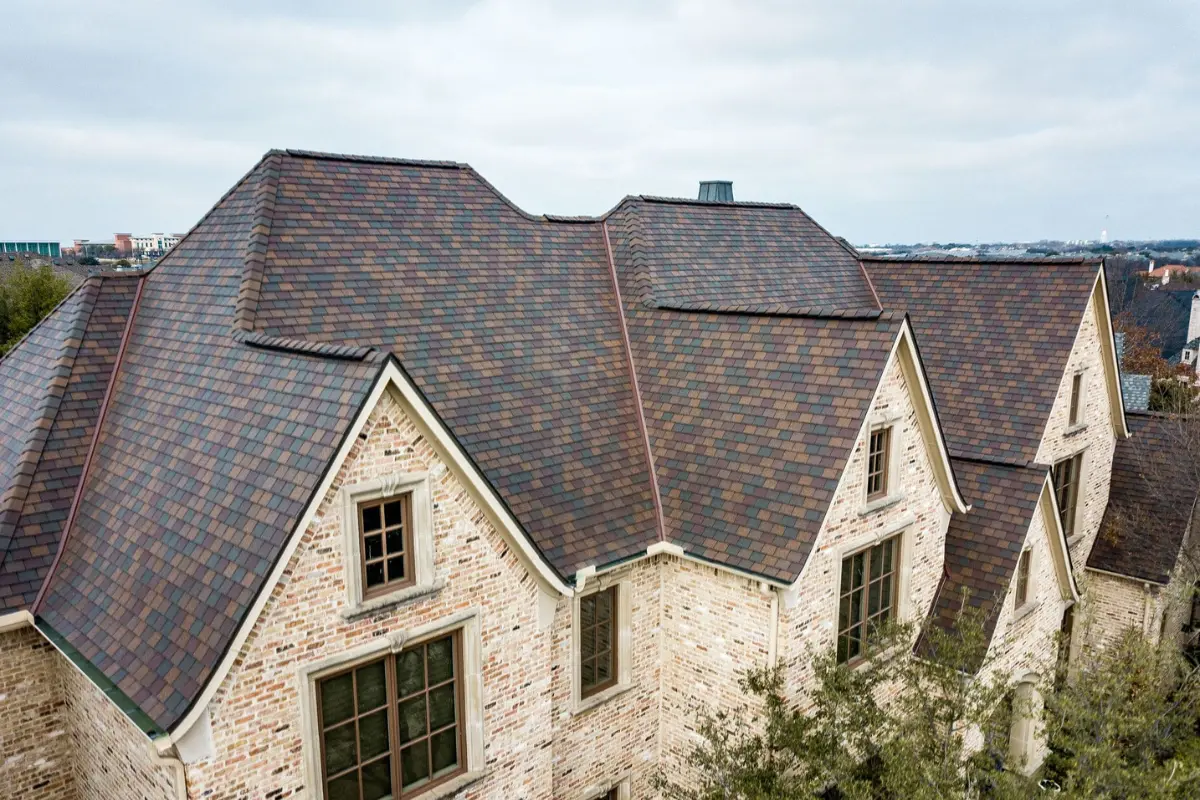
Lakeway roofs are large, steep, and complicated. Custom rooflines over limestone hillsides, heavy tile and metal, live oak and cedar canopy overhead, and genuine hail and wildfire exposure make this the most technically demanding market we work in.
Roofing in Lakeway, and why it isn't like anywhere else
Lakeway sits on the south shore of Lake Travis, west of Austin, on Hill Country limestone with a thin caliche mantle rather than the deep clay of the eastern metro. That single geologic fact changes the whole engineering conversation. Foundations here move far less than they do in Pflugerville or Cibolo, so the recurring chimney-flashing failures that dominate clay markets are not the leading call in Lakeway. What dominates instead is geometry: multi-level rooflines on cliffside and hillside lots, long valleys, deep dead-valleys against two-story walls, and large roof areas that a single storm can expose all at once.
The housing stock is heavily custom, and the material mix reflects it — concrete and clay tile, standing seam metal, and premium architectural or Class 4 asphalt in roughly equal measure. Homes sit under mature live oak and cedar, which means real leaf and needle load in the gutters and a genuine limb-impact risk in high wind. Wildfire exposure through the cedar breaks is not theoretical, and Class A assembly detail matters here in a way it does not east of the escarpment.
Practically, two other things shape every Lakeway project: almost every neighborhood runs architectural review through an HOA with real color and profile restrictions, and the City of Lakeway operates its own building department. Both need to be handled before a crew shows up, not after.
How Lakeway weather actually loads your roof
Hill Country exposure on steep terrain: hail off the lake, wind that accelerates over ridgelines, heavy canopy, and wildfire risk in the cedar.
What we see most often on Lakeway roofs
Why roofs actually fail, from a systems point of view
Atrium Roofing is engineer-led. Here's how we think about your roof as a system, not a stack of shingles.
In most Central Texas markets we start with soil. In Lakeway we start with geometry. A typical Lakeway custom has several times the number of roof planes, valleys, hips, and wall terminations of a production home of similar square footage, and every one of those intersections is a place water can be mishandled. The field of the roof rarely fails first. The intersections do.
That drives how we scope work here. We budget disproportionate time to valley construction, wall flashing, crickets behind chimneys and above roof-to-wall transitions, and penetration detail. On a steep multi-level roof, a valley is not a place to run shingles together and trust the seal. It gets a full-width ice-and-water membrane and a metal or properly woven detail sized for the drainage area feeding it.
Class 4 impact and metal as the practical choices
Given the hail record over the lake, we recommend either Class 4 impact-rated asphalt orstanding seam metal for most Lakeway homes replacing an asphalt roof. Metal costs more up front and is the better long-horizon choice on simple-to-moderate rooflines; on a very cut-up custom, the fabrication cost climbs steeply and Class 4 asphalt often carries the better value. Either way, the insurance discount for an impact-rated system is worth submitting.
Wildfire-resistant Class A assemblies
Wildfire risk here is real, and roofs are the surface that catches embers. A Class A rated assembly — not just a Class A shingle, but the underlayment and deck it sits on — plus ember-resistant soffit and ridge venting, metal drip edge, and valleys kept clear of needle litter is the practical package. Tile and metal both perform well; the detail work at eaves and vents is what separates a compliant assembly from a nominal one.
Gutters sized for canopy, not for square footage
Standard gutter sizing tables assume a clean trough. Under Lakeway's oak and cedar canopy, the effective capacity is lower all year. We size up, add downspout count rather than downspout diameter alone, and specify guards here — one of the few markets where guards genuinely earn their cost.
When we tell you to wait
A tile roof with intact tile and a failing underlayment can often be lifted, re-underlaid, and reset for meaningfully less than a full replacement. A metal roof with backed-out fasteners may need a fastener and flashing program rather than new panels. We will tell you when that is the right call.
Three paths, and how to know which one fits
What roofing actually costs in Lakeway
Lakeway is the highest-cost market we serve. Large custom homes, steep pitches, difficult hillside access, and a heavy tile and metal mix all push the number up. Ranges are 2026 figures for typical Lakeway single-family homes and assume normal — not cliffside-crane — access. These are ranges based on typical local jobs, and the actual number depends on your roof.
- Roof area and the number of planes, valleys, and wall terminations.
- Pitch, and whether crews need staging or fall-protection anchors on hillside lots.
- Site access — narrow drives, cliffside setbacks, and material staging distance.
- Material class: asphalt versus metal versus concrete or clay tile.
- HOA architectural review requirements on color and profile.
- Gutter linear footage, downspout count, and whether guards are included.
Paying for a roof without draining savings
Lakeway projects are larger than our Central Texas average, and on a metal or tile roof the useful way to evaluate cost is annualized over service life rather than as a single number. Financing terms run 60 to 180 months. Financing is subject to credit approval. The terms shown here are examples, and your actual rate, term, and payment depend on the lender's decision.
On an insurance-funded job, the deductible is usually the only real out-of-pocket, and financing it is common. Atrium offers 0% APR financing for up to 12 months, subject to credit approval.
Roof systems that hold up in Lakeway
These aren't the cheapest options. They're the ones that actually make it to their warranty on Central Texas roofs.
Atrium's 5 Engineered Systems
Available on any Lakeway roof. Full assemblies, not just shingles. Your install may be eligible for a registered manufacturer system warranty.
Roof characteristics by Lakeway neighborhood
Housing stock, roof age, and the failure modes we see most often, block by block.
Around Lakeway
A little context helps calibrate what a roof in this specific community faces.
Roofing services we deliver in Lakeway, TX
Hillside customs in Rough Hollow and Flintrock Falls, tile roofs in The Hills, and newer production stock in Lakeway Highlands are three different jobs. We scope and price them that way.
Roof replacement in Lakeway covers a wider material range than anywhere else we work. On asphalt homes we most often install a Class 4 impact-rated system — Malarkey Legacy or GAF Armorshield II — with full tearoff, synthetic underlayment, full-width ice-and-water membrane in every valley and at wall lines, all new flashings, crickets behind chimneys and at dead valleys, upgraded ridge and soffit ventilation, and a manufacturer system warranty registered in the homeowner's name. On tile and standing seam projects we handle HOA architectural submittals and City of Lakeway permitting as part of the scope.
Roof repair in Lakeway concentrates on intersections rather than fields. Valley rebuilds, dead-valley crickets and membrane, wall flashing and kickouts at two-story terminations, cracked tile replacement, and fastener and flashing programs on older exposed-fastener metal are the bulk of the work. On steep hillside roofs we set proper anchors and staging rather than working off a ladder, which is part of why repair pricing here starts higher than in the eastern metro.
Storm damage roof repair after Lake Travis basin hail and ridgeline wind is predictable seasonal work. We inspect at no cost, document functional damage with dated photos and measurements, and tell you honestly whether a claim clears your deductible — which on Lakeway dwelling limits is a higher bar than most markets. Read the hail damage guide for how functional and cosmetic damage differ.
Gutter installation and gutter repair is a substantial service line here because of canopy load. We install 6-inch seamless aluminum with added downspout count, guards specified as standard given the live oak and cedar drop, and discharge extensions that carry water clear of hillside cuts and retaining walls. Repairs cover re-pitching sagging runs, resealing miters, replacing hail-dented sections, and clearing packed downspout outlets. Our seamless gutter installation and repair guide covers sizing and downspout spacing in detail.
Wildfire-resilience work is specific to this market. Ember-resistant soffit and ridge venting, metal drip edge, Class A assembly verification, and keeping valleys and gutters clear of cedar litter are the measures that actually change outcomes at the roof plane.
Ventilation and attic performance work matters on Lakeway's large roof areas even under canopy. Balanced intake at the soffit with continuous ridge exhaust lowers deck temperature, extends shingle and underlayment life, and reduces cooling load. See our attic ventilation guide for the underlying physics.
How Lakeway's terrain and weather actually damage roofs
Steep limestone terrain, hail off the lake, wind that accelerates over exposed ridges, dense oak and cedar canopy, and real wildfire exposure. Each is a distinct load, and none of them is the clay-soil story that dominates the eastern metro.
Terrain and roof geometry. This is the defining local condition. Building on steep limestone hillsides produces multi-level rooflines with many planes, long valleys, and lower roofs terminating into two-story walls. Water that would be spread across a simple gable on a production home gets concentrated into a handful of valleys here. A valley detailed for a small drainage area but fed by a large one will overshoot or back up under the shingles, and that is the leak we are most often called to fix.
Hail. The Lake Travis basin sees recurring 1"–2" hail. Class 3 and Class 4 are UL 2218 lab steel-ball ratings, not real-hail guarantees, and no shingle is hail-proof; many carriers discount Class 4, so ask yours. Concrete and clay tile crack under larger stones, and metal panels dent — cosmetically on the flats, functionally when a seam or clip is compromised.
Ridgeline wind. Wind accelerates as it climbs the escarpment and crosses exposed ridges above the lake. Rake edges, hip and ridge starters, and tile field fasteners take that load first. Hand-sealed caps, starter strip along every rake and eave, and correct fastener patterns are baseline on any Lakeway reroof.
Canopy load. Live oak and cedar drop year-round, not seasonally. Debris packs gutters, fills valleys, and holds moisture against the roof surface. On a steep roof an overflowing gutter throws concentrated water down the hillside, which matters for landscaping and retaining walls as much as for the house.
Wildfire. The cedar breaks around Lakeway carry genuine fire risk, and the roof is the surface most likely to catch an ember. The realistic ignition paths are unscreened vents, accumulated needle litter in valleys and gutters, and exposed eave framing. Class A assemblies with ember-resistant venting and a maintenance habit close most of that gap.
Thin caliche over limestone. Worth stating plainly because it is the opposite of the eastern metro: Lakeway soils move very little. If a Lakeway roofer tells you your recurring leak is foundation movement, ask for the evidence. Here it is almost always geometry or workmanship.
Lakeway, TX — where we work
We serve homeowners throughout Lakeway and the Lake Travis corridor — from Lakeway proper and Old Lakeway near the marina, through The Hills, Flintrock Falls, and Rough Hollow, to Serene Hills and Lakeway Highlands along RM 620.
What homeowners actually say
Published, verifiable reviews from third-party platforms, not marketing copy.
Lakeway homeowner questions
Related resources
Let's take a look at your roof in Lakeway.
No pressure, no obligation. Calls answered 24/7 in English & español by Alex, our AI specialist · Get an engineer-led 53-point roof inspection, not a sales pitch.