
Understanding Hail Damage: What It Looks Like and What It Means
Most hail damage is not obvious from the ground. How hail damages a shingle, how to tell functional damage from cosmetic, and when it warrants a claim.
- A 2-inch stone has 8 times the mass of a 1-inch stone and falls faster, so it hits with roughly 16 times the energy.
- Functional damage fractures the shingle mat; cosmetic damage only affects appearance.
- Circular patterns of displaced granules are the primary field indicator.
- Bruised (spongy underfoot) shingles have mat fracture even when the surface looks normal.
- Collateral damage on soft metals (gutters, vents, AC fins) confirms hail was large enough to matter.
- Policies vary, and most require prompt notice. Practically, file within a year of the dated storm event, and sooner is better because proving which storm caused the damage gets harder as more storms pass over.
- Document with photos, dates, and NOAA hail reports before any adjuster arrives.
Table of contents
- How hail actually damages a shingle
- Why stone size matters more than count
- Functional damage vs cosmetic damage
- Identifying hail damage on a shingle
- Class 3 vs Class 4 shingles: how impact rating changes the outcome
- When to inspect after a storm
- Documenting damage for insurance
- An engineer's perspective
- Why this matters in Texas
- Common mistakes
- Warning signs
- Cost considerations
- Repair vs replace
- Engineer's recommendation
- FAQ
- Sources & technical references
How hail actually damages a shingle
A hailstone is a lump of ice that formed when a supercell updraft carried raindrops repeatedly above the freezing line. The stone grows in concentric layers until the updraft can no longer support it, then falls at roughly 9 to 40 mph for stones up to about 1.75 inches and 44 to 72 mph for 2 to 4 inch stones, with the very largest possibly exceeding 100 mph.1 When it hits a roof, its kinetic energy transfers to the shingle in a fraction of a second.
That impact does three things simultaneously: it displaces granules from the surface, it compresses the asphalt-fiberglass mat, and if energy is high enough, it fractures the mat. Granules can be measured; mat fracture requires touch and trained eyes.
Why stone size matters more than count
A 2-inch stone has 8 times the mass of a 1-inch stone and falls faster, so it hits with roughly 16 times the energy. Kinetic energy grows with mass times speed squared, and a hailstone's terminal speed grows with the square root of its diameter. A brief storm dropping a few 2-inch stones is far more destructive than a long storm producing thousands of pea-sized hits.
From Atrium inspections since 2016 General field guidance from our inspections, for asphalt shingles:
- Under 1 inch: rarely causes functional damage on healthy shingles.
- 1 to 1.5 inches: may bruise aging shingles; needs a hands-on inspection.
- 1.5 to 1.75 inches: borderline; damage depends on shingle class and age.
- 1.75 inches and up: typically produces clear functional damage.
These bands shift with shingle type, age, condition and wind, so treat them as a starting point for an inspection, not a damage determination.
Functional damage vs cosmetic damage
Functional damage shortens the shingle's service life. It includes mat fracture, granule loss down to the asphalt, and impact "bruises" that feel spongy underfoot. These allow UV to reach the asphalt binder directly, so the damaged shingles age faster and fail sooner than the rest of the roof.
Cosmetic damage affects only appearance — dents in metal trim, marks on soft metals that don't compromise function. Whether cosmetic marks are covered depends on your policy. Many Texas policies now exclude cosmetic roof damage by endorsement. Check yours. This distinction is central to any roof insurance claim.
Identifying hail damage on a shingle
What to look for
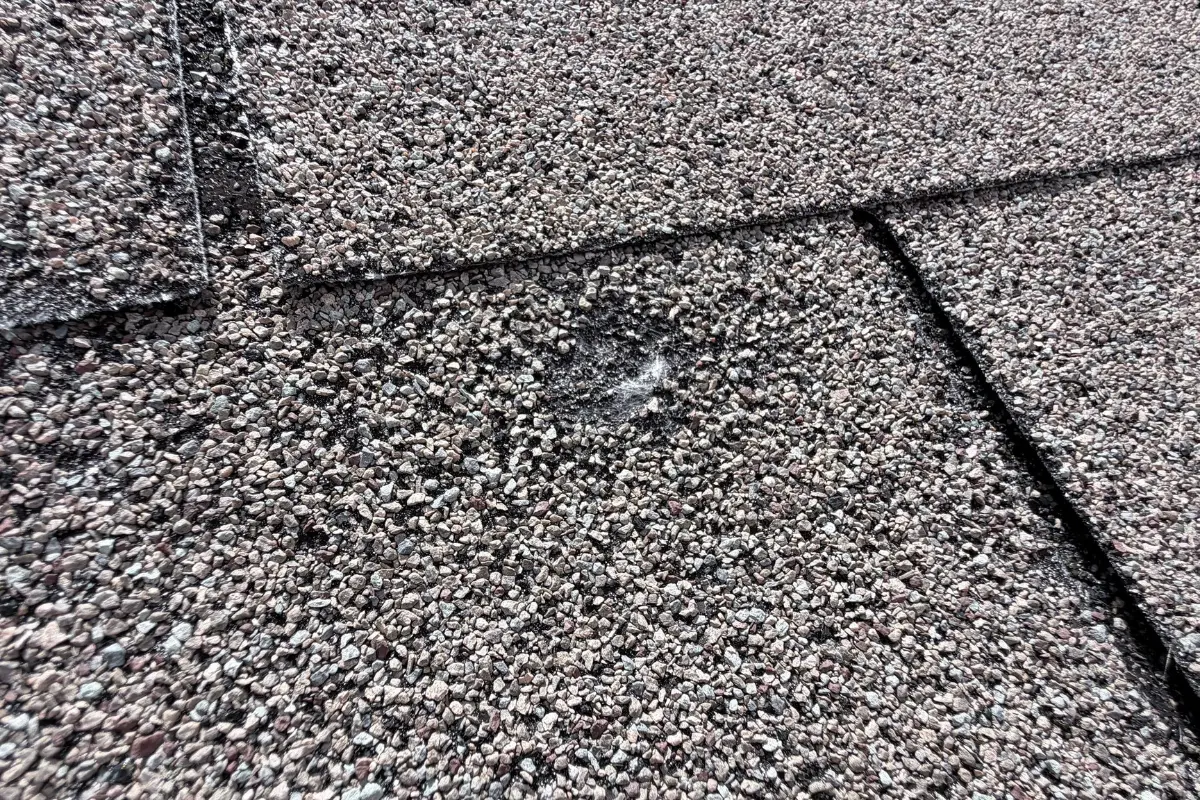
- Circular displacement of granules — small round bare spots roughly the size of the hail that fell.
- Exposed asphalt visible at the impact center.
- Fresh appearance — the exposed asphalt is dark and matte, not weathered.
- Bruising — press on the shingle; if it feels soft or spongy, the mat is fractured underneath.
- Random distribution — hail hits are random and directional, unlike wear patterns which are uniform.
What to check as collateral evidence
- Dents in soft aluminum vents, gutters, downspouts, and AC condenser fins.
- Splatter marks on wooden fences, decks, or painted surfaces.
- Damage to skylight domes, plastic vent covers, or solar tubes.
Collateral damage on soft metals is one of the most reliable indicators that hail was large enough to matter — adjusters look at it as much as the shingles themselves.
Class 3 vs Class 4 shingles: how impact rating changes the outcome
The UL 2218 impact resistance standard rates shingles on their ability to survive a steel-ball drop simulating hail. Class 3 uses a 1.75-inch steel ball dropped 17 feet; Class 4 a 2-inch ball dropped 20 feet.2 A lab steel ball is not real hail, and no shingle is hail-proof. Many Class 4 shingles use SBS-modified (rubberized) asphalt, though not all do. At our published rates the upgrade costs about 17 to 20% more.
Class 4 impact-resistant shingles can qualify for a premium discount in Texas. The amount is set by your insurance carrier, so ask your agent what yours would be. Full comparison in Class 3 vs Class 4 shingles.
When to inspect after a storm
Inspect within 30 days of a hail event. Fresh hail damage shows dark asphalt exposure that weathers to gray within a few months, making it harder to distinguish from ordinary wear. Insurance carriers also check the storm date when they evaluate a claim, and waiting makes it harder to tie the damage to a specific storm.
Never inspect your own roof after a storm — wet shingles, hidden bruising, and steep slopes make falls common. Have a qualified roofer or public adjuster walk it. See our full storm damage response guide for the sequence.
Documenting damage for insurance
Before any adjuster arrives, collect:
- Photos of every damaged slope, close-ups of individual hits, and all collateral damage.
- NOAA Storm Prediction Center report for the storm date and your ZIP code.
- Interior photos of any ceiling stains or attic evidence.
- Roofer's inspection report with a written scope.
A thorough documentation packet gives the adjuster a clear record of what's on the roof. Details in our insurance claim guide.
The physics and building science behind this
Hail damage is one of the few roof issues where the actual failure is buried inside the shingle mat, not visible on the surface. You can walk a hail-hit roof and see nothing dramatic — a few bare spots that look like ordinary granule loss. Push on those spots, and the shingle deflects like a bruise on soft fruit. That's fractured mat. UV will find the exposed asphalt within a year, and the shingle will crack and lift long before its rated life.
The reason insurance carriers argue over hail claims is that this damage is genuinely hard to distinguish from wear at a glance. Good documentation, like timestamped photos, NOAA data and dents on soft metals, gives the adjuster a clear record to work from.
Central Texas climate changes the answer
Central Texas sits in one of the most active hail corridors in the country. From late February through early June, warm Gulf moisture and cold Rocky Mountain air collide over the I-35 belt, spawning supercells that can drop damaging hail across San Antonio, New Braunfels, Boerne, and Austin. In the NOAA hail reports in our regional dataset, Bexar County alone has logged 136 hail reports (point reports, not separate storms) since June 3, 2021.3 On April 12, 2016, hail up to 4.5 inches fell on San Antonio and caused about $1.36 billion in damage.4 More detail in our San Antonio hail data.
The result: insurance carriers in Central Texas treat hail claims with more scrutiny than almost anywhere else in the country. Documentation matters more here. Class 4 shingle uptake is also higher here, because the extra hail exposure makes the upgrade easier to justify.
Common mistakes
- Waiting too long after a storm to file. Policies vary, and most require prompt notice. Practically, file within a year of the dated storm event, and sooner is better because proving which storm caused the damage gets harder as more storms pass over.
- Signing an 'assignment of benefits' with a storm-chaser roofer before your own inspection.
- Refusing to pay your deductible. Texas law requires you to pay your deductible (Texas Insurance Code §707.002), and it is an offense for a contractor to waive or cover it.
- Assuming small hail can't cause damage — aging shingles fail at smaller stone sizes.
- Filing a claim without independent documentation, letting the adjuster's photos be the only record.
- Confusing algae streaks or blister damage with hail hits.
- Not documenting collateral damage on gutters, vents, and AC fins.
Warning signs to watch for
- Fresh dark spots on shingles a few days after a storm.
- Granule accumulation in gutters and downspouts.
- Bruised, spongy areas when the roof is walked.
- Dents in aluminum gutters, downspouts, or vent hoods.
- Cracked skylight covers or plastic vent caps.
- Splatter marks on wood fences or painted trim.
- Interior ceiling stains appearing weeks or months after a storm.
Cost considerations
From Atrium inspections since 2016 Our hail inspection is free. Most reputable roofers don't charge for one either. At Atrium, repairs for isolated damage start at $497. On a replacement-cost (RCV) policy, an approved replacement typically leaves you paying the deductible plus anything the carrier does not cover. On an actual-cash-value (ACV) roof schedule, the carrier also subtracts depreciation, which can be a large share of the cost on an older roof. Many Texas policies set a separate wind and hail deductible as a percentage of your dwelling coverage. On a $400,000 dwelling limit, every 1% is $4,000. Your declarations page shows yours. Out-of-pocket replacement without a claim runs about $14,500 to $17,400 for architectural shingles on a typical 2,400 sq ft home footprint at our published rates, more for Class 4, premium shingles or metal. See the full Central Texas cost guide.
Repair vs replacement guidance
Isolated hail hits on a young, healthy roof can sometimes be repaired shingle-by-shingle, but color match is imperfect and matting under a repaired shingle can hide damage. Adjusters mark a 10 by 10 foot test square on each slope and count functional hail hits inside it. Each carrier sets its own threshold for how many hits justify replacing that slope, and those thresholds are internal, not published. High counts on a slope point toward replacing that slope rather than patching it. High counts across multiple slopes point toward a full replacement. See repair vs replacement for the decision framework.
Frequently asked questions
Sources & technical references
Codes & standards
- [2]UL 2218 impact classes: steel-ball diameters and drop heights. Fabral (summary of UL 2218). fabral.com/wp-content/uploads/2016/10/CLASS-A-FIRE-RATINGS-AND-UL-2218-HAIL-IMPACT-RATING.pdf. Accessed October 25, 2026.
Government data
- [1]Severe Weather 101: Hail Basics. NOAA National Severe Storms Laboratory. www.nssl.noaa.gov/education/svrwx101/hail/. Accessed November 17, 2026.
- [3]NOAA hail reports, Bexar County and surrounding counties. NOAA storm reports, as compiled in Atrium's hail-events-bexar-region dataset. Accessed October 25, 2026.
- [4]San Antonio April 2016 weather event summary (hail to 4.5 inches, about $1.36 billion in damage). National Weather Service Austin/San Antonio. www.weather.gov/media/ewx/wxevents/ewx-20160412.pdf. Accessed October 27, 2026.
Still have questions?
Talk with Atrium Roofing's engineering-led team before making a roofing decision. We give straight answers, walk your roof in person when needed, and never pressure you into a scope you don't need.