The Roof You Only Have to Buy Once
Why quality shingles, real ventilation, and honest pricing beat San Antonio's every-7-years replacement habit — and why insurance may not bail you out next time. A free engineer-led guide from Jose Puente.
10-page PDF · Free · No email required
What's inside
Six things a homeowner in this market should be able to answer before signing a roofing proposal.
How Central Texas got trained to treat a 25-year product as a 7-year consumable.
Rising wind-and-hail deductibles and the shift toward Actual Cash Value payouts on roofs.
The annualized cost math on buying one built system instead of two cheap ones.
Balanced intake and exhaust in plain language, and what an unbalanced attic does to shingles.
The specific things to require in writing before you sign any roofing proposal.
Financing options, and the legal way to handle a deductible you can't cover today.
The habit
A 25-year product, replaced every seven to ten years, and almost nobody asks why.
Central Texas sits under one of the most active hail corridors in the country, and for two decades the insurance response to that was simple: a qualifying storm produced a claim, the claim produced a full replacement, and the homeowner paid a deductible that was often one percent of the dwelling value. Repeat every seven to ten years. The system worked well enough that it quietly rewrote what homeowners believe a roof is.
The consequence is that quality stopped being a question anyone asked. If the roof was going to be replaced again on someone else's dollar in eight years, then underlayment, flashing detail, and attic ventilation were irrelevant details, and the only rational move was to take the cheapest bid and pocket the difference. An entire local market organized itself around that logic — thin scopes, reused flashing, no ventilation math, and a price low enough to win.
Meanwhile the shingles themselves are rated for twenty-five to thirty years. The gap between what the product is capable of and what homeowners here actually get out of it is not a manufacturing problem. It is an installation and expectation problem. For the material-by-material breakdown of what actually lasts in this climate, read how long roofs last in Texas.
Why this matters right now
The safety net that made the habit affordable is being withdrawn.
Two changes are landing at the same time. The first is deductibles. The old Texas standard for wind and hail was one percent of the dwelling coverage. Two percent is becoming the 2026 standard on new and renewing policies, and in higher-risk parts of the state carriers are writing three to five percent. On a $400,000 dwelling, that is the difference between a $4,000 out-of-pocket cost and $12,000 to $20,000 for the same storm.
The second is what the carrier pays on the other side of that deductible. Effective March 18, 2026, Fannie Mae and Freddie Mac revised their insurance requirements to allow policies that pay Actual Cash Value on roofs rather than full replacement cost. ACV pays the depreciated value of what was up there, not what it costs to put a new one on. On a twelve-year-old roof, depreciation can consume most of the payout, and the homeowner covers the rest.
Put together: a bigger deductible, a smaller check, and the same hailstorm. A roof built to survive the next two storms stops being a preference and starts being the cheaper path. And if anyone offers to make the deductible disappear, read Texas's deductible-waiver law before you say yes — it is an offense under state law, and it exposes you as well as them.
The math
Two cheap roofs and one built roof land in the same place annualized — except you live through the second one twice.
Roofing is priced by the square, meaning one hundred square feet of roof surface. Here are Atrium's actual installed ranges, and what each works out to per year if the system reaches a 25-year service life instead of being torn off in year eight.
| System | Installed, per square | Per square, per year at 25 years |
|---|---|---|
| Laminated (Architectural) Shingles | $475 – $600 | $19 – $24 |
| Impact-Resistant (Class 4) Shingles | $550 – $700 | $22 – $28 |
| Designer / Premium Impact Shingles | $800 – $1,000 | $32 – $40 |
| Standing Seam Metal | $800 – $1,300 | $32 – $52 |
The annualized numbers converge, which is the point. What does not converge is everything around them: a second tear-off means paying full labor a second time, living through a second week of noise and debris, absorbing a second deductible under the new higher percentages, and betting a second time that the payout covers it. Buying once is not primarily about the per-year cost. It is about not being on the hook for the whole event again in eight years. Run your own address through the full cost guide and calculator.
The engineer-led difference
Why our number lands in the middle of the bids you collect, not at the bottom.
Collect four roofing bids in San Antonio and they will spread wider than the work justifies. The low bid is not low because someone found a cheaper shingle. It is low because the scope quietly omits things a homeowner cannot see: new flashing at every wall and penetration, synthetic underlayment instead of felt, decking replacement where it is actually needed, and an intake-to-exhaust ventilation calculation rather than whatever was on the roof before.
Atrium was founded by a civil engineer, and every scope is checked against a written standard before it is priced. That produces a number in the middle of the range and a scope that specifies what the assembly is, by product name, in writing. The tradeoff is honest and we state it plainly: if the only criterion is today's price, we will lose that comparison. If the criterion is what the roof costs across its life, the middle bid with the complete scope is the cheaper one.
More on the background and how it changes the way a scope gets written: about Jose Puente.
The physics of ventilation
What goes in must come out — and in most attics here, it doesn't.
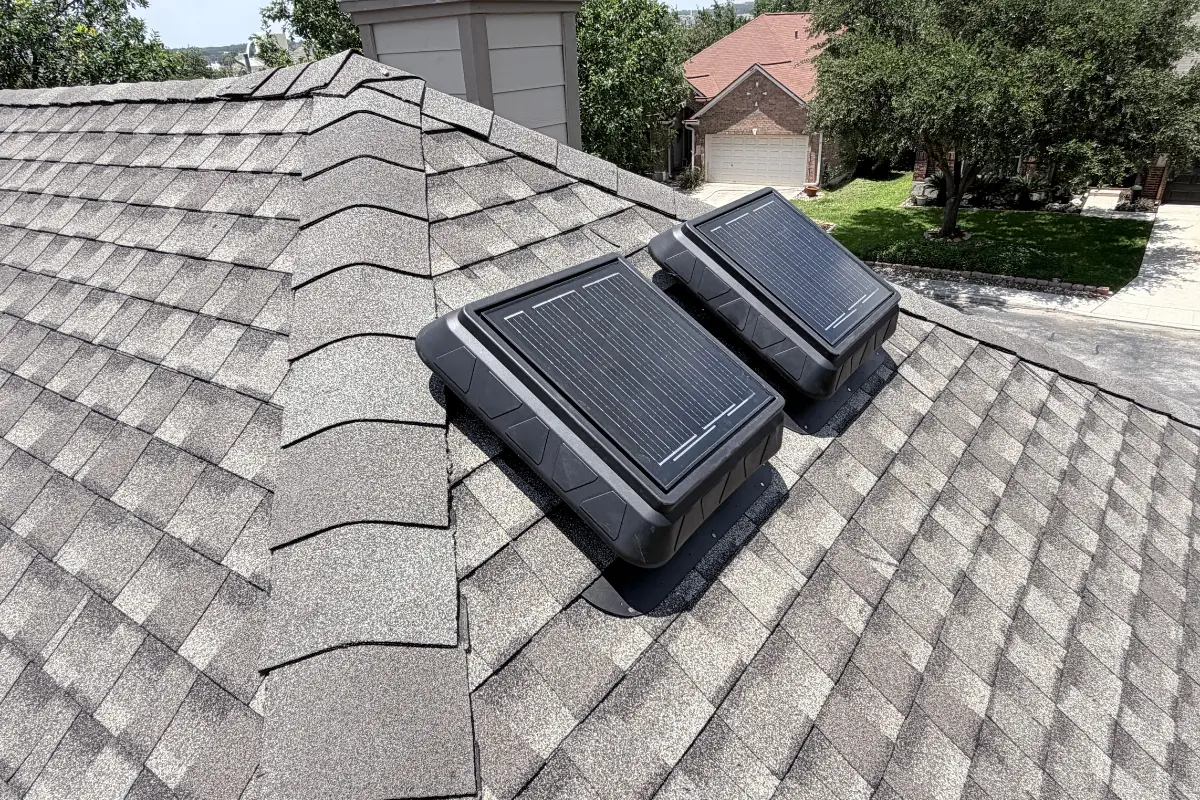
An attic works like a chimney. Cool air enters low at the soffits, warms, rises, and leaves high at the ridge. That loop only functions if the intake area and the exhaust area are balanced. Exhaust without matching intake cannot pull air from anywhere except the house itself; intake without exhaust has nowhere to go. Either way, the loop stalls and the attic becomes a heat trap.
A stalled attic in a South Texas summer routinely runs well above outdoor temperature, and the shingles sit directly on top of it, cooking from below as well as above. Asphalt ages by losing volatiles to heat. Accelerate that and a shingle rated for decades reaches the end of its useful life in a fraction of the time — while the manufacturer's warranty, which assumes a properly ventilated deck, may not respond to the result.
The fix is arithmetic, not opinion: net free intake area measured against exhaust against roof area. We run that calculation on every inspection. For the full engineering breakdown, read attic ventilation science.
What "built once" requires
Five things to require in writing, and the two warranty layers underneath them.
- 1Every slope photographed
Not just the storm side. You receive the photographs, dated, whether or not you hire us.
- 2Ventilation calculated, not guessed
Net free intake area measured against exhaust and roof area, with the numbers shown to you.
- 3Flashing rebuilt, not reused
Walls, chimneys, and penetrations get new metal. Reused flashing is the most common hidden shortcut in this market.
- 4Products named in writing
Manufacturer, line, and underlayment specified on the proposal — and, on shingle replacements, the supplier's material invoice handed over at closeout.
- 5Engineered scopes
Every assembly is specified to a documented standard before it is priced, not after a problem shows up.
A manufacturer-backed system warranty ranks above any contractor's own warranty for one reason: it survives the contractor. If a roofing company closes, changes hands, or simply stops answering the phone, a warranty backed by Owens Corning or GAF is still honored. A contractor's warranty is only worth as much as the contractor still being in business, and that is as true of ours as it is of anyone's.
Atrium holds Owens Corning Platinum Preferred, the top tier of the Owens Corning contractor network, which makes the enhanced Owens Corning system warranty available on our installs. We also hold GAF Certified Plus, which makes the GAF Silver Pledge available. These system warranties cover material and, at these tiers, workmanship, and they are registered with the manufacturer in your name.
Underneath that layer sits ours. Atrium backs every roof replacement with a written 10-year workmanship warranty. It is non-prorated, so coverage in year ten is identical to year one, and it is fully transferable to the next owner. If a covered installation defect appears, we cover the labor and the materials to correct it.
Every one of these claims is backed by paperwork you actually receive — see the Power Package, the documents you get when the job is done, depending on your roofing system.
Paying for it
A built-once roof does not have to be paid for all at once.
Financing exists so the right scope is not decided by what is in checking this month. Financing is subject to credit approval, and the lender makes the decision. You see the monthly payment before anything is committed. The details, terms, and current programs are on the financing page.
The same applies to a deductible you cannot cover today. Under HB 2102 a contractor cannot waive, absorb, or rebate it — but a homeowner is free to finance it, which is the legal and honest version of the same relief. If a company offers to make it disappear instead, read the Texas deductible law first.
Homeowner guide FAQs
Related reading
Up to five documents you receive when the job is finished, depending on your roofing system.
ReadMonthly payment options, subject to credit approval.
ReadWhy “we'll waive your deductible” is a red flag, not a discount.
ReadThe full engineering breakdown of intake, exhaust, and heat.
ReadMaterial-by-material service life in this climate.
ReadThe engineering background behind how we write a scope.
ReadWhat a full engineered replacement includes, start to finish.
ReadThe guide is free and there is no email gate. The inspection is free too, and you keep the photographs either way.
10-page PDF · Free · No email required